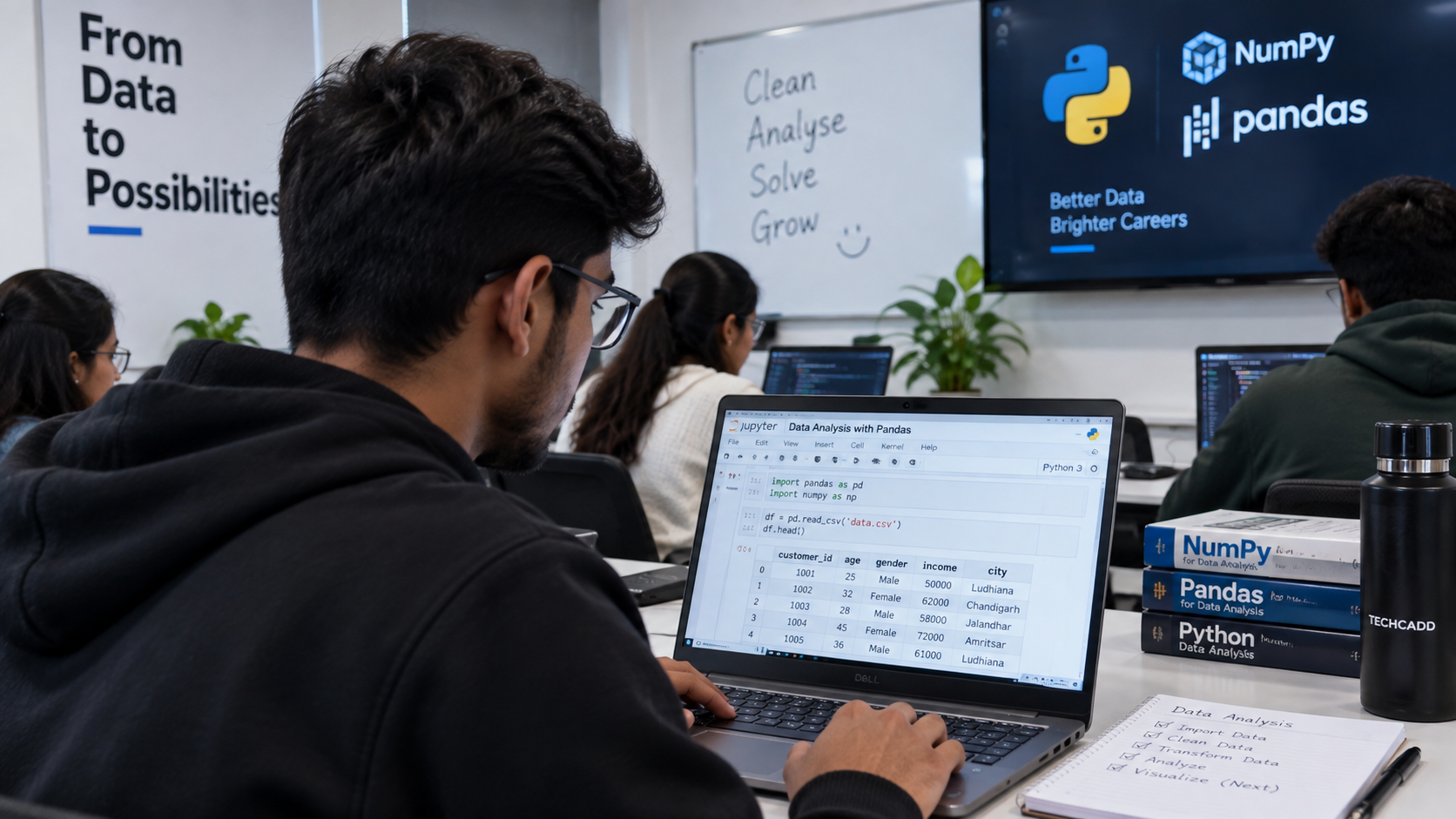
Learn to turn raw datasets into structured, analysis-ready data using Python.
Learn to work with real datasets using Python, NumPy and Pandas. Practise numerical operations, DataFrames, filtering, data cleaning and transformation through structured hands-on exercises.
Learn Python for Data Analysis through practical experience
The Python for Data Analysis Course in Ludhiana develops practical skills for working with structured and numerical data using Python.
Learners use NumPy for arrays and numerical operations before progressing to Pandas for Series, DataFrames, dataset inspection, filtering and transformation.
The course then applies these tools to common data-quality problems such as missing values, duplicates and inconsistent information.
The outcome is practical: take a raw dataset, inspect it, clean it and prepare it for further analysis.
hybrid
Curriculum
A path from first steps to shipped work
4 modules and 32 topics across Flexible batches, in the order they are taught. Each one closes with something that works before the next one opens.
4 learning modules01 / 04
Module 01 · Module 1
NumPy Fundamentals
Learn how NumPy represents numerical information and how arrays can be created, accessed and manipulated using Python.
Topics covered
Introduction to NumPy
NumPy arrays
Array creation
Array dimensions
Array shapes
Indexing
Slicing
Numerical operations
You finish with
Numerical data-processing exercises
Module 02 · Module 2
Working with Pandas
Learn how Pandas represents structured datasets and how to inspect, select, filter and organise tabular information.
Topics covered
Introduction to Pandas
Series
DataFrames
Importing datasets
Viewing dataset structure
Selecting rows and columns
Filtering records
Sorting data
You finish with
Structured DataFrame analysis
Module 03 · Module 3
Data Cleaning
Identify common data-quality problems and use Pandas operations to prepare cleaner and more consistent datasets.
Topics covered
Missing values
Duplicate records
Data Types
Incorrect values
Replacing values
Filtering
Data transformation
Data validation
You finish with
Cleaned dataset
Module 04 · Module 4
Practical Dataset Analysis
Combine NumPy and Pandas skills to take a dataset from initial inspection through cleaning and structured preparation.
Topics covered
Dataset inspection
Column selection
Conditional filtering
Sorting
Basic aggregation
Data transformation
Dataset preparation
Analysis workflow
You finish with
Analysis-ready dataset
What you learn
What You Will Learn in Python for Data Analysis
Learn how Python, NumPy and Pandas work together to turn raw numerical and tabular information into structured data that can be inspected, cleaned and prepared for analysis.
01
NumPy arrays
Create and manipulate NumPy arrays for structured numerical operations.
02
Numerical operations
Use indexing, slicing and array operations to access and transform numerical information.
03
Pandas DataFrames
Use Series and DataFrames to represent and work with structured datasets.
04
Dataset filtering
Select rows, columns and records according to specific analytical requirements.
05
Data cleaning
Handle missing values, duplicates and inconsistent data before further analysis.
06
Data preparation
Transform a raw dataset into a structured, cleaner and analysis-ready form.
Tools you’ll work with
Python
NumPy
Pandas
The practical outcome is the ability to take a dataset from initial loading and inspection through cleaning and structured preparation.
Find your pace
What you can do, phase by phase
The Python for Data Analysis syllabus in the order you meet it, and what you are able to do by the end of each stretch of it. Every row is a capability, not a topic you sat through.
Every capability in the Python for Data Analysis syllabus, and the phase it is covered in
Capability
Python for Data Analysis
Introduction to NumPyNumPy Fundamentals
Covered in Python for Data Analysis
NumPy arraysNumPy Fundamentals
Covered in Python for Data Analysis
Array creationNumPy Fundamentals
Covered in Python for Data Analysis
Array dimensionsNumPy Fundamentals
Covered in Python for Data Analysis
Array shapesNumPy Fundamentals
Covered in Python for Data Analysis
IndexingNumPy Fundamentals
Covered in Python for Data Analysis
SlicingNumPy Fundamentals
Covered in Python for Data Analysis
Numerical operationsNumPy Fundamentals
Covered in Python for Data Analysis
Introduction to PandasWorking with Pandas
Covered in Python for Data Analysis
SeriesWorking with Pandas
Covered in Python for Data Analysis
DataFramesWorking with Pandas
Covered in Python for Data Analysis
Importing datasetsWorking with Pandas
Covered in Python for Data Analysis
Viewing dataset structureWorking with Pandas
Covered in Python for Data Analysis
Selecting rows and columnsWorking with Pandas
Covered in Python for Data Analysis
Filtering recordsWorking with Pandas
Covered in Python for Data Analysis
Sorting dataWorking with Pandas
Covered in Python for Data Analysis
Missing valuesData Cleaning
Covered in Python for Data Analysis
Duplicate recordsData Cleaning
Covered in Python for Data Analysis
Data TypesData Cleaning
Covered in Python for Data Analysis
Incorrect valuesData Cleaning
Covered in Python for Data Analysis
Replacing valuesData Cleaning
Covered in Python for Data Analysis
FilteringData Cleaning
Covered in Python for Data Analysis
Data transformationData Cleaning
Covered in Python for Data Analysis
Data validationData Cleaning
Covered in Python for Data Analysis
Dataset inspectionPractical Dataset Analysis
Covered in Python for Data Analysis
Column selectionPractical Dataset Analysis
Covered in Python for Data Analysis
Conditional filteringPractical Dataset Analysis
Covered in Python for Data Analysis
SortingPractical Dataset Analysis
Covered in Python for Data Analysis
Basic aggregationPractical Dataset Analysis
Covered in Python for Data Analysis
Data transformationPractical Dataset Analysis
Covered in Python for Data Analysis
Dataset preparationPractical Dataset Analysis
Covered in Python for Data Analysis
Analysis workflowPractical Dataset Analysis
Covered in Python for Data Analysis
The full programme runs Flexible batches. Where you finish is a question of pace rather than of syllabus — everyone covers all of it.
The case for it
Real Data Needs More Than Basic Python
Basic Python teaches programming logic. NumPy and Pandas extend that foundation into practical data work by helping learners organise numerical information, work with rows and columns, clean datasets and prepare information for analysis.
2Core Python data librariesNumPy and Pandas
Use NumPy arrays to store, access and manipulate numerical information.
Use Pandas DataFrames to organise and inspect structured datasets with rows and columns.
Identify missing values, duplicates and inconsistent information before analysis.
Filter, sort and transform raw information into a structured dataset ready for further analysis.
Why this course
Why should you choose this course?
Six things we hold ourselves to for every Python for Data Analysis batch that starts in Ludhiana.
01
NumPy Practice
Develop practical experience working with numerical arrays and array operations.
02
Pandas Practice
Use DataFrames to organise, filter and manipulate structured information.
03
Data Cleaning Skills
Learn a repeatable process for identifying and correcting common data-quality problems.
04
Practical Dataset Work
Apply individual commands to datasets rather than learning library syntax in isolation.
05
Analysis Foundation
Prepare structured datasets that can later be used for exploratory analysis, visualisation and machine learning.
Why TechCadd
Why students choose us for this
The learning sequence moves from Python programming into NumPy and Pandas before introducing more advanced analytical subjects, keeping each stage focused on skills students can demonstrate.
Structured progression
Learn Python data handling before moving into visualisation, statistics or machine learning.
Tool-specific practice
Use NumPy for numerical data and Pandas for structured datasets instead of treating “data analysis” as one broad theory topic.
Dataset-based learning
Apply concepts to structured datasets so learners can see how each operation changes the underlying information.
Cleaning before analysis
Learn to inspect and prepare data before attempting to draw conclusions from it.
Practical deliverable
Finish with a cleaned, structured dataset that demonstrates the skills covered in the course.
Who can join
Who this Python for Data Analysis course is for
This course is for learners who understand basic Python and want to start using it to work with structured data and real datasets.
Python Learners
Move beyond basic Python programming into practical numerical and tabular data processing.
College Students
Develop practical data-handling skills that complement programming, computing or analytical study.
Aspiring Data Analysts
Build the Python data-handling foundation needed before progressing into visualisation, statistics and deeper analysis.
Working Professionals
Learn how Python can be used to organise, clean and process structured workplace data.
What you actually need before day one
Flexible batches · hybrid
A laptop or desktop — we help you set it up in the first session
A stable internet connection for the online batches
No prior coding or technical background
Basic English reading — the tools and their documentation are in English
About 6-8 hours a week outside class for practice
Willingness to finish the lab task before the next class
Not sure which of these you are, or whether the timing works around what you already do? That is exactly what the call is for. Ask about Python for Data Analysis
Technology ecosystem
One discipline. A mesh of real tools.
Python for Data Analysis is the centre. These are the tools you use around it in a working team.
Python for Data Analysiscore skill
Programming Language
Numerical Computing Library
Data Analysis Library
PythonProgramming Language
NumPyNumerical Computing Library
PandasData Analysis Library
Hands-on projects
Projects you actually ship, not just follow along with.
Each one lands in your portfolio with the working files, the process and something a reviewer can open.
Certification
Get certified in Python for Data Analysis
Finish the Python for Data Analysis programme at techcadd Ludhiana and you leave with more than a line on a CV — a verifiable certificate, and the project work that makes it mean something in an interview.
Course completion certificate
Issued in your name on completion of the Python for Data Analysis syllabus, with a reference number an employer can verify with us.
Project certificate
A separate certificate for the capstone you submit, naming the project so the work is attached to the credential.
Internship letter
Students who complete the live-project phase receive an internship letter covering the duration and the work delivered.
Portfolio you own
Every file, repository and deployed link stays yours — the part of the credential a reviewer can actually open.
techcadd has been training in Ludhiana since 2007. The certificate carries that record; the Python for Data Analysis work you did carries the rest.
Course completion
This is to certify that
has successfully completed the Python for Data Analysis programme
Python for Data Analysis
Project & internship
This is to certify that
for project work delivered under supervision in Ludhiana
Python for Data Analysis capstone
Where it takes you
Where this course takes you
The route from your first module to the roles Python for Data Analysis opens — and the work that has to exist at each step.
01Learning
02Projects
03Portfolio
04Industry readiness
05Career opportunities
Data Analyst Trainee
Demonstrate the ability to load, inspect, filter and clean structured datasets using Python and Pandas.
Junior Data Analyst
Show practical understanding of dataset structure, data quality and basic Python-based data preparation.
Python Data Trainee
Use Python, NumPy and Pandas to perform supervised numerical and structured data-processing tasks.
Data Intern
Demonstrate that raw information can be organised, cleaned and prepared correctly for further analysis.
Salary outlook
What Python for Data Analysis pays, and where
Indicative ranges for the roles this course opens — what a fresher out of Ludhiana is offered, what the metro and remote markets pay for the same skills, and how that moves with two or three years of work behind you.
Indicative annual packages by role and market
Role
Ludhiana & Punjab
Delhi NCR & Bengaluru
Remote & freelance
Data Analyst TraineeEntry
₹2.4–4.2 LPA
₹4–8 LPA
₹20k–45k / project
Junior Data AnalystEntry to mid
₹3.6–6.5 LPA
₹6.5–14 LPA
₹35k–90k / project
Python Data TraineeEntry to mid
₹3.6–6.5 LPA
₹6.5–14 LPA
₹35k–90k / project
Data InternMid
₹3.6–6.5 LPA
₹6.5–14 LPA
₹35k–90k / project
Ranges are indicative, drawn from what our own students report and from openings we see through the placement cell. Actual offers depend on your portfolio, the interview and the company — nobody can promise you a number, and we do not.
Data Analyst Trainee, Junior Data Analyst, Python Data Trainee, Data Intern and related positions, depending on which part of the syllabus you go deepest on.
The first jump usually comes at 18–24 months, once you have shipped work you can point to. Depth in one area moves it faster than breadth across many.
Yes, and a good number of our students do. Remote and contract work is the reason Ludhiana candidates now compete for the same briefs as metro ones — the portfolio travels, the address does not matter.
IT services, manufacturing and export units running automation, e-commerce and D2C brands, healthcare, education, and the agencies serving all of them. Punjab hiring is broader than it looks from a job board.
It helps with the practical half. The projects and tooling carry into an M.Tech, MCA or a specialisation abroad, and the portfolio is often what separates two applicants with the same marks.
Future scope
What Comes After NumPy and Pandas?
Once learners can confidently work with structured datasets, they are better prepared to progress into exploratory analysis, data visualisation, statistics and machine learning.
Year 0–1
Get in on proof of work
Entry roles such as Data Analyst Trainee open as soon as you have projects that run. At this stage nobody is asking about your marks — they are asking you to walk through something you built.
Year 2–4
Specialise and get paid for it
The generalists plateau; the specialists do not. Depth in one part of Python for Data Analysis — the part your first job leans on hardest — is what moves you towards junior data analyst work.
Year 5+
Own the decisions
Architecture, standards, hiring and mentoring. The technical skill is assumed by now; what you are paid for is judgement, and judgement only comes from having shipped things that mattered.
Data Preparation
Useful analysis starts with structured, consistent data that can be inspected and processed reliably.
Python-Based Analysis
Python allows learners to move from programming into data handling without changing languages.
Reusable Data Workflows
NumPy and Pandas operations can be combined into repeatable workflows for cleaning and transforming datasets.
Python-based data skills can support analytical work across
IT Services
Manufacturing
Finance
Education
Business Services
Retail
The comparison
Why students pick techcadd for Python for Data Analysis
This comparison focuses on how the course develops practical Python data-handling skills rather than comparing unsupported claims about individual training providers.
techcadd compared with a other institutes, feature by feature
What to ask about
techcadd
Other institutes
Starting point
Builds on Python fundamentals before introducing data libraries.
Prerequisite structures vary by course.
NumPy
Covers arrays and practical numerical operations.
NumPy coverage varies by curriculum.
Pandas
Uses Series and DataFrames for structured dataset work.
Pandas depth depends on the programme.
Data cleaning
Includes practical handling of common dataset-quality problems.
Cleaning depth varies by course structure.
Practical work
Skills are applied through structured dataset exercises.
Practical requirements vary by provider.
Outcome
Learners work toward producing a cleaned, analysis-ready dataset.
Final deliverables differ by programme.
Compare data-analysis training by the datasets learners can actually inspect, clean and prepare—not simply by the number of libraries listed.
Student Voices
WhatPythonforDataAnalysislearnerssay
Feedback from students who completed the Python for Data Analysis programme at techcadd Ludhiana.
I joined with no background in this. By the third month I was building Python for Data Analysis work on my own, and the project reviews are where I actually learnt to do it properly.
HS
Harman Sethi
Python for Data Analysis / Now working as an intern in the field
The classes are practical. Every session ends with a task that has to work, so you cannot fake understanding. That habit helped me most in interviews.
AV
Ankit Verma
Python for Data Analysis / BCA final year
Doubt support was the difference for me. My trainer sat with my work, found the mistake and made me fix it myself instead of handing over the answer.
SK
Simranjeet Kaur
Python for Data Analysis / B.Sc. IT graduate
I joined with no background in this. By the third month I was building Python for Data Analysis work on my own, and the project reviews are where I actually learnt to do it properly.
HS
Harman Sethi
Python for Data Analysis / Now working as an intern in the field
The classes are practical. Every session ends with a task that has to work, so you cannot fake understanding. That habit helped me most in interviews.
AV
Ankit Verma
Python for Data Analysis / BCA final year
Doubt support was the difference for me. My trainer sat with my work, found the mistake and made me fix it myself instead of handing over the answer.
NS
Navjot Singh
Python for Data Analysis / Career switch from operations
I came for the skill and left with a portfolio — projects I could actually demo on a call, not a certificate I had to explain.
SK
Simranjeet Kaur
Python for Data Analysis / B.Sc. IT graduate
I joined with no background in this. By the third month I was building Python for Data Analysis work on my own, and the project reviews are where I actually learnt to do it properly.
HS
Harman Sethi
Python for Data Analysis / Now working as an intern in the field
The classes are practical. Every session ends with a task that has to work, so you cannot fake understanding. That habit helped me most in interviews.
NS
Navjot Singh
Python for Data Analysis / Career switch from operations
I came for the skill and left with a portfolio — projects I could actually demo on a call, not a certificate I had to explain.
SK
Simranjeet Kaur
Python for Data Analysis / B.Sc. IT graduate
I joined with no background in this. By the third month I was building Python for Data Analysis work on my own, and the project reviews are where I actually learnt to do it properly.
HS
Harman Sethi
Python for Data Analysis / Now working as an intern in the field
The classes are practical. Every session ends with a task that has to work, so you cannot fake understanding. That habit helped me most in interviews.
AV
Ankit Verma
Python for Data Analysis / BCA final year
Doubt support was the difference for me. My trainer sat with my work, found the mistake and made me fix it myself instead of handing over the answer.
NS
Navjot Singh
Python for Data Analysis / Career switch from operations
I came for the skill and left with a portfolio — projects I could actually demo on a call, not a certificate I had to explain.
SK
Simranjeet Kaur
Python for Data Analysis / B.Sc. IT graduate
I joined with no background in this. By the third month I was building Python for Data Analysis work on my own, and the project reviews are where I actually learnt to do it properly.
AV
Ankit Verma
Python for Data Analysis / BCA final year
Doubt support was the difference for me. My trainer sat with my work, found the mistake and made me fix it myself instead of handing over the answer.
NS
Navjot Singh
Python for Data Analysis / Career switch from operations
I came for the skill and left with a portfolio — projects I could actually demo on a call, not a certificate I had to explain.
SK
Simranjeet Kaur
Python for Data Analysis / B.Sc. IT graduate
I joined with no background in this. By the third month I was building Python for Data Analysis work on my own, and the project reviews are where I actually learnt to do it properly.
HS
Harman Sethi
Python for Data Analysis / Now working as an intern in the field
The classes are practical. Every session ends with a task that has to work, so you cannot fake understanding. That habit helped me most in interviews.
AV
Ankit Verma
Python for Data Analysis / BCA final year
Doubt support was the difference for me. My trainer sat with my work, found the mistake and made me fix it myself instead of handing over the answer.
NS
Navjot Singh
Python for Data Analysis / Career switch from operations
I came for the skill and left with a portfolio — projects I could actually demo on a call, not a certificate I had to explain.
HS
Harman Sethi
Python for Data Analysis / Now working as an intern in the field
The classes are practical. Every session ends with a task that has to work, so you cannot fake understanding. That habit helped me most in interviews.
AV
Ankit Verma
Python for Data Analysis / BCA final year
Doubt support was the difference for me. My trainer sat with my work, found the mistake and made me fix it myself instead of handing over the answer.
NS
Navjot Singh
Python for Data Analysis / Career switch from operations
I came for the skill and left with a portfolio — projects I could actually demo on a call, not a certificate I had to explain.
Real, unedited feedback from techcadd learners on Google.
Frequently asked questions
Questions before you enrol
The 7 things people ask most often about the Python for Data Analysis course at techcadd Ludhiana.
The complete Python for Data Analysis programme runs for Flexible batches depending on the batch you choose. Weekday, weekend and fast-track options are available, along with shorter modules for students who only need the fundamentals.
School students after 12th, college students from any stream, graduates and working professionals changing track. The first module assumes no prior experience.
No. The course starts from the basics. If you already have some background, your trainer will move you faster through the first module so you reach the project work sooner.
Python, NumPy and Pandas — plus the day-to-day tooling and workflow that surrounds them in a real team.
Yes. Each module closes with a lab project, and the course ends with a capstone you can put on your portfolio and defend in an interview.
Placement support includes resume and portfolio review, aptitude and role-specific practice, mock interviews and interview referrals through our hiring network.
Yes. You receive a techcadd Python for Data Analysis completion certificate, and a separate project certificate for the capstone you submit.
Next batch
Enquire about Python for Data Analysis
Send this form and a counsellor calls you back about this course
specifically — batch dates, fees and whether it fits what you already
know.