Systems that act, not just answer

Give AI tools.Keep it accountable.

Tool use, planning loops, memory, multi-agent orchestration and the guardrails that make an autonomous system safe enough to run against real data.

 3 monthsClassroom & online batchesBeginner to job ready
Explore course
4.8/5
Student rating
500+
Students trained
6+
Industry projects
Yes
Placement support
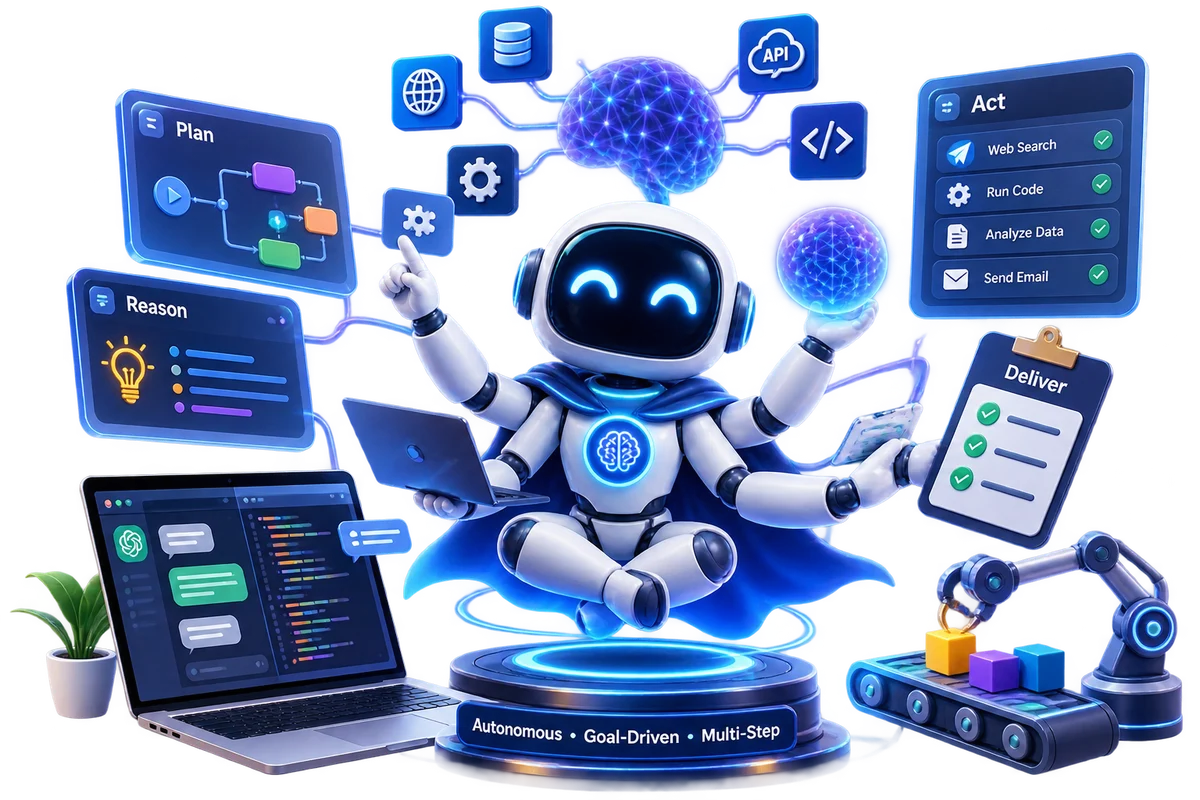
An agentic AI setup — a multi-armed assistant planning, reasoning and acting across tools, with the run log beside it

Admissions open

Free demo class & counselling

Batch slots

  • Weekday
  • Evening
  • Weekend
Talk to a counsellor

Course overview

The Agentic AI course in Ludhiana for engineers who want to build systems, not chatbots

The Agentic AI course in Ludhiana at techcadd covers what happens after a model can answer: tool definitions, agent loops, planning, memory, error recovery, human approval checkpoints and multi-agent patterns that do not quietly destroy something.

An agent is a language model that can act — call your functions, query your database, send your email, update your records. That single change turns every mistake from an embarrassing answer into an actual consequence, which is why this is the most engineering-heavy course in our AI track and why it is not the one to start with.

You will build agents that complete real multi-step work and, more importantly, agents that fail safely: retries with backoff, tool errors handled rather than swallowed, budget and step limits, an audit trail of what was done, and human approval in front of anything irreversible. Multi-agent patterns are taught with their costs stated plainly, because most problems that look like they need five agents need one agent and a better tool.

Prerequisite is real: Python plus some experience calling an LLM API. Take the Generative AI course first if either is new — students who skip that step spend this course learning the previous one.

  • Every agent ships with a human approval path
  • Failure handling designed in, not bolted on
  • Costs and loops bounded by construction

Curriculum

A path from first steps to shipped work

4 modules and 22 topics across 3 months, in the order they are taught. Each one closes with something that works before the next one opens.

4 learning modules01 / 04
Module 01 · Weeks 1–2

Agent Foundations

What separates an agent from a chatbot, and where the pattern genuinely earns its complexity.

Topics covered

  • Agent loops
  • State & context
  • When not to use an agent
  • Cost modelling
  • Step budgets

Tools & libraries

  • Python
  • Claude API

You finish with

A minimal agent loop you wrote yourself, with a hard step limit.

Module 02 · Weeks 3–5

Tool Use & Function Calling

Defining tools a model can call reliably, and handling what happens when a call fails.

Topics covered

  • Tool schemas
  • Parameter validation
  • Error recovery
  • Idempotency
  • Retry policy
  • Tool selection

Tools & libraries

  • Claude API
  • Pydantic
  • MCP

You finish with

A five-tool agent that recovers cleanly from every failure mode you test.

Module 03 · Weeks 6–8

Memory, Planning & Retrieval

Giving an agent the context to work across steps, sessions and documents.

Topics covered

  • Short & long-term memory
  • Task decomposition
  • Planning strategies
  • RAG integration
  • Context compaction

Tools & libraries

  • LangGraph
  • FAISS
  • Redis

You finish with

An agent that completes a multi-session task without losing what it already did.

Module 04 · Weeks 9–12

Multi-Agent Systems & Safety

Orchestration, review agents, approval gates and running the whole thing in production.

Topics covered

  • Orchestrator patterns
  • Specialist agents
  • Critic & review loops
  • Human-in-the-loop
  • Audit logging
  • Deployment

Tools & libraries

  • LangGraph
  • FastAPI
  • Docker
  • MCP

You finish with

Your capstone multi-agent system deployed with a full audit trail and approval gates.

The part most courses skip

Building agents that fail safely

Any tutorial can show you an agent that works. This section of the agentic AI training is about the far more common case, and it is the reason the course exists.

  1. Limits before capabilities

    Step budgets, token budgets, wall-clock timeouts and spend caps go in before the agent does anything interesting. An agent without limits is not a prototype, it is a bill.

  2. Human approval on anything irreversible

    Sending, paying, deleting, publishing. The approval checkpoint is a design pattern you implement in week one and apply to every project after it.

  3. Tool errors are the normal case

    APIs time out, return nonsense and change shape. You learn to hand errors back to the model usefully, retry with backoff, and give up loudly rather than quietly.

  4. An audit trail somebody can read

    Every run logs what was decided, which tool was called with what, and what came back. When a client asks why the agent did something at 3am, this is the difference between an answer and an apology.

This is also, in practice, the interview. Senior engineers ask about failure, not features.

Find your pace

What you can do, phase by phase

The Agentic AI syllabus in the order you meet it, and what you are able to do by the end of each stretch of it. Every row is a capability, not a topic you sat through.

Every capability in the Agentic AI syllabus, and the phase it is covered in
CapabilityFoundationsAppliedProfessional
Agent loopsAgent FoundationsCovered in FoundationsCovered in AppliedCovered in Professional
State & contextAgent FoundationsCovered in FoundationsCovered in AppliedCovered in Professional
When not to use an agentAgent FoundationsCovered in FoundationsCovered in AppliedCovered in Professional
Cost modellingAgent FoundationsCovered in FoundationsCovered in AppliedCovered in Professional
Step budgetsAgent FoundationsCovered in FoundationsCovered in AppliedCovered in Professional
Tool schemasTool Use & Function CallingCovered in FoundationsCovered in AppliedCovered in Professional
Parameter validationTool Use & Function CallingCovered in FoundationsCovered in AppliedCovered in Professional
Error recoveryTool Use & Function CallingCovered in FoundationsCovered in AppliedCovered in Professional
IdempotencyTool Use & Function CallingCovered in FoundationsCovered in AppliedCovered in Professional
Retry policyTool Use & Function CallingCovered in FoundationsCovered in AppliedCovered in Professional
Tool selectionTool Use & Function CallingCovered in FoundationsCovered in AppliedCovered in Professional
Short & long-term memoryMemory, Planning & RetrievalNot yet covered in FoundationsCovered in AppliedCovered in Professional
Task decompositionMemory, Planning & RetrievalNot yet covered in FoundationsCovered in AppliedCovered in Professional
Planning strategiesMemory, Planning & RetrievalNot yet covered in FoundationsCovered in AppliedCovered in Professional
RAG integrationMemory, Planning & RetrievalNot yet covered in FoundationsCovered in AppliedCovered in Professional
Context compactionMemory, Planning & RetrievalNot yet covered in FoundationsCovered in AppliedCovered in Professional
Orchestrator patternsMulti-Agent Systems & SafetyNot yet covered in FoundationsNot yet covered in AppliedCovered in Professional
Specialist agentsMulti-Agent Systems & SafetyNot yet covered in FoundationsNot yet covered in AppliedCovered in Professional
Critic & review loopsMulti-Agent Systems & SafetyNot yet covered in FoundationsNot yet covered in AppliedCovered in Professional
Human-in-the-loopMulti-Agent Systems & SafetyNot yet covered in FoundationsNot yet covered in AppliedCovered in Professional
Audit loggingMulti-Agent Systems & SafetyNot yet covered in FoundationsNot yet covered in AppliedCovered in Professional
DeploymentMulti-Agent Systems & SafetyNot yet covered in FoundationsNot yet covered in AppliedCovered in Professional

The full programme runs 3 months. Where you finish is a question of pace rather than of syllabus — everyone covers all of it.

The case for it

The moment an AI can act, "mostly right" stops being good enough.

Everything in this programme follows from that sentence. Approval steps, budgets, audit trails and recovery are not advanced topics here; they are the first week, because they are what makes an agent shippable.

4Agents built and deployedeach with limits, logging and a human in the loop
  • You learn AI agents the way it is used in production, with the workflow, tooling and standards a working team expects. Nothing in the syllabus exists only to fill hours.

  • Sessions are hands-on. You do every example, break it, and fix it. Each module closes with a lab task that has to work before you move on.

  • Four shipped finished projects — the kind of work an interviewer can open, click through and question you on.

  • A structured final phase: portfolio review, profile cleanup, aptitude and role-specific practice, mock interviews and placement support.

Why this course

Why should you choose this course?

Six things we hold ourselves to for every Agentic AI batch that starts in Ludhiana.

  • 01

    Industry-focused curriculum

    Syllabus built around what AI agents teams actually ship — no filler modules, no theory that never reaches your hands.

  • 02

    Practical learning

    Every concept lands in the tool the same day. You work in AI agents during each class, not just in your notes.

  • 03

    Real-world projects

    Build with real requirements, real data and real problems — from the first task to a finished, reviewable deliverable.

  • 04

    Mentor guidance

    Trainers who work with AI agents daily review your work, your logic and your approach line by line.

  • 05

    Career preparation

    Resume, portfolio, aptitude rounds and interview practice built into the last phase of the course.

  • 06

    Placement support

    Interview referrals, mock rounds and continued doubt support after the course ends.

Who can join

Who this Agentic AI course is for

Six kinds of people sit in a typical batch, and none of them arrive knowing AI agents. Find the one that sounds like you.

  • Students after 12th

    You have finished school and want a skill that pays before a degree does. The first module assumes you have never opened AI agents in your life.

    No background needed
  • College students

    BCA, B.Tech, B.Sc, BBA, B.Com — any stream. You learn AI agents alongside your degree and finish with projects your syllabus was never going to give you.

    Weekend batches
  • Final year and fresh graduates

    You are months away from interviews and need work to show, not marks to quote. The final phase is portfolio, mock rounds and referrals.

    Placement support
  • Working professionals

    You already have a job and want AI agents on top of it. Evening and weekend batches exist for exactly this, and the project work is yours to schedule.

    Evening batches
  • Career switchers

    You are coming from a different field entirely — operations, teaching, accounts, sales. Every module starts from why, not from jargon.

    Start from zero
  • Freelancers and business owners

    You want to do this work yourself instead of paying for it. You leave able to build, run and judge AI agents work on your own terms.

    Practical only

What you actually need before day one

3 months · Classroom & online batches

  • A laptop or desktop — we help you set it up in the first session
  • A stable internet connection for the online batches
  • Python and some experience calling an LLM API. The Generative AI course is the natural prerequisite if you have neither.
  • Basic English reading — the tools and their documentation are in English
  • About 6-8 hours a week outside class for practice
  • Willingness to finish the lab task before the next class

Not sure which of these you are, or whether the timing works around what you already do? That is exactly what the call is for. Ask about Agentic AI

Technology ecosystem

One discipline.
A mesh of real tools.

Agentic AI is the centre. These are the tools you use around it in a working team.

  • Agent reasoning
  • Agent orchestration
  • Standard tool protocol
  • Retrieval memory
  • Session state
  • Agent services
  • Sandboxed execution
  • Implementation language
  • Claude APIAgent reasoning
  • LangGraphAgent orchestration
  • MCPStandard tool protocol
  • FAISSRetrieval memory
  • RedisSession state
  • FastAPIAgent services
  • DockerSandboxed execution
  • PythonImplementation language

Hands-on projects

Projects you actually ship,
not just follow along with.

Each one lands in your portfolio with the working files, the process and something a reviewer can open.

Capstone project

Operations Agent with Approval Gates

A supervised multi-agent system that triages incoming requests, researches context, drafts a response and executes an action — with a critic agent reviewing every plan, a human approval gate on anything irreversible, bounded step and cost budgets, and a full audit log.

  • LangGraph
  • MCP
  • Human-in-loop
  • Audit
Difficulty
Advanced
Status
Deployed
View project brief

Certification

Get certified in Agentic AI

A techcadd Agentic AI certificate, an internship letter for the live-project phase, and deployed agents with their tool definitions, guardrails and run logs — the evidence a senior engineer will actually read.

  • Course completion certificate

    Issued in your name on completion of the Agentic AI syllabus, with a reference number an employer can verify with us.

  • Project certificate

    A separate certificate for the capstone you submit, naming the project so the work is attached to the credential.

  • Internship letter

    Students who complete the live-project phase receive an internship letter covering the duration and the work delivered.

  • Portfolio you own

    Every file, repository and deployed link stays yours — the part of the credential a reviewer can actually open.

techcadd has been training in Ludhiana since 2007. The certificate carries that record; the AI agents work you did carries the rest.

Course completion

This is to certify that

has successfully completed the Agentic AI programme

Agentic AI Course

Ref TC-XXXX-XXXX
Project & internship

This is to certify that

for project work delivered under supervision in Ludhiana

Agentic AI capstone

Ref TC-PRJ-XXXX

Where it takes you

Where this course takes you

The route from your first module to the roles Agentic AI opens — and the work that has to exist at each step.

  1. 01Learning
  2. 02Projects
  3. 03Portfolio
  4. 04Industry readiness
  5. 05Career opportunities
  • AI Agent Developer

    Design and ship autonomous systems for real workflows.

  • Generative AI Engineer

    Build the agentic layer of an AI product.

  • Automation Architect

    Replace multi-step manual processes with supervised agents.

  • AI Platform Engineer

    Run the infrastructure agents execute on, safely.

  • AI Solutions Consultant

    Scope where agents help a business and where they will not.

  • AI Product Engineer

    Own agentic features from prototype to production.

Salary outlook

What agent engineering pays

Agentic work is the highest-paid corner of the AI stack and the smallest. There are few local openings with this exact title; the roles below are the ones this skill wins.

Indicative annual packages by role and market
RoleLudhiana & PunjabDelhi NCR & BengaluruRemote & freelance
AI Agent DeveloperEntry to mid₹4–7 LPA₹8–18 LPA₹60k–1.8L / project
Generative AI EngineerEntry to mid₹3.6–6.5 LPA₹7–16 LPA₹50k–1.4L / project
AI Automation EngineerEntry to mid₹3.5–6.5 LPA₹6.5–14 LPA₹45k–1.2L / project
AI Solutions ArchitectMid (3–5 yrs)₹8–14 LPA₹16–32 LPA₹2L–5L / project

Ranges are indicative, drawn from what our own students report and from openings we see through the placement cell. Actual offers depend on your portfolio, the interview and the company — nobody can promise you a number, and we do not.

  • AI agent developer, generative AI engineer, AI automation engineer and, with a few years behind it, AI solutions architect. Job titles in this area are unsettled — most postings describe the work rather than name it, so search by what the role does.

  • Fast, from a high base, for a simple reason: very few engineers can demonstrate an agent that runs unsupervised without a horror story attached. Reliability work is the differentiator and it is what this course spends its time on.

  • Predominantly remote, and often international. Agent work is contracted globally and reviewed on artefacts — repository, run logs, evaluation — which suits an engineer in Ludhiana as well as one anywhere else.

  • Locally the demand comes from IT services firms, logistics and distribution operations around Ludhiana, larger manufacturing groups automating procurement and back-office work, and e-commerce sellers. Product companies in Mohali, Chandigarh, NCR and Bengaluru are the deeper market, and most of it is remote-friendly.

  • It is applied engineering rather than a research subject, but it is unusually strong evidence for a research-track application — an agent with a proper evaluation harness is close to a systems paper in miniature.

Future scope

The road ahead for AI agents

A course ends; the field does not. Here is the honest version of what the next few years look like for AI agents — where the roles go, and what is shifting underneath them while you learn.

  1. Year 0–1

    Get in on proof of work

    Entry roles such as AI Agent Developer open as soon as you have projects that run. At this stage nobody is asking about your marks — they are asking you to walk through something you built.

  2. Year 2–4

    Specialise and get paid for it

    The generalists plateau; the specialists do not. Depth in one part of AI agents — the part your first job leans on hardest — is what moves you towards generative ai engineer work.

  3. Year 5+

    Own the decisions

    Architecture, standards, hiring and mentoring. The technical skill is assumed by now; what you are paid for is judgement, and judgement only comes from having shipped things that mattered.

Sectors hiring for this skill set

  • IT services
  • Product startups
  • Banking & fintech
  • Healthcare
  • E-commerce
  • Manufacturing
  • EdTech
  • Government & PSUs

The comparison

Why students pick techcadd for Agentic AI

Every institute in Ludhiana claims industry training and placement support. These are the differences you can actually check on a demo visit — ask any of them of anyone, including us.

techcadd compared with a typical institute, feature by feature
What to ask abouttechcaddTypical institute
Who teachesTrainers who still do AI agents work outside the classroomFull-time faculty teaching from a fixed deck
1-on-1 classesOne-to-one teaching available on every course — the pace is yours, and your work is looked at by nameOne group class moving at one pace, whoever that pace happens to suit
Project work5 real projects plus a capstone you deploy and defendGuided exercises copied from the board
CurriculumReviewed every batch against what working teams shipUpdated when the printed syllabus is reprinted
How a module endsA lab task that has to run before you move onNotes to revise before an exam
Doubt supportTrainer sits with your code; open lab hours between classesAsk at the end of class if there is time left
What you leave withCompletion certificate, project certificate, internship letter — all verifiableOne printed certificate
After the coursePortfolio review, mock interviews, referrals, continued doubt supportThe course ends and so does the contact

Written about the market, not about any particular institute in it. Visit two or three, sit through a demo class at each, and ask all eight of these questions — that is the only version of this table worth trusting.

Student Voices

What Agentic AI learners say

Feedback from students who completed the Agentic AI programme at techcadd Ludhiana.

Google Reviews4.8from 181 Google reviewsGoogle Verified
SK

Simranjeet Kaur

Agentic AI / B.Sc. IT graduate

I joined with no background in this. By the third month I was building AI agents work on my own, and the project reviews are where I actually learnt to do it properly.

Posted on Google
HS

Harman Sethi

Agentic AI / Now working as an intern in the field

The classes are practical. Every session ends with a task that has to work, so you cannot fake understanding. That habit helped me most in interviews.

Posted on Google
AV

Ankit Verma

Agentic AI / BCA final year

Doubt support was the difference for me. My trainer sat with my work, found the mistake and made me fix it myself instead of handing over the answer.

Posted on Google
NS

Navjot Singh

Agentic AI / Career switch from operations

I came for the skill and left with a portfolio — projects I could actually demo on a call, not a certificate I had to explain.

Posted on Google
SK

Simranjeet Kaur

Agentic AI / B.Sc. IT graduate

I joined with no background in this. By the third month I was building AI agents work on my own, and the project reviews are where I actually learnt to do it properly.

Posted on Google
HS

Harman Sethi

Agentic AI / Now working as an intern in the field

The classes are practical. Every session ends with a task that has to work, so you cannot fake understanding. That habit helped me most in interviews.

Posted on Google
AV

Ankit Verma

Agentic AI / BCA final year

Doubt support was the difference for me. My trainer sat with my work, found the mistake and made me fix it myself instead of handing over the answer.

Posted on Google
NS

Navjot Singh

Agentic AI / Career switch from operations

I came for the skill and left with a portfolio — projects I could actually demo on a call, not a certificate I had to explain.

Posted on Google
SK

Simranjeet Kaur

Agentic AI / B.Sc. IT graduate

I joined with no background in this. By the third month I was building AI agents work on my own, and the project reviews are where I actually learnt to do it properly.

Posted on Google
HS

Harman Sethi

Agentic AI / Now working as an intern in the field

The classes are practical. Every session ends with a task that has to work, so you cannot fake understanding. That habit helped me most in interviews.

Posted on Google
AV

Ankit Verma

Agentic AI / BCA final year

Doubt support was the difference for me. My trainer sat with my work, found the mistake and made me fix it myself instead of handing over the answer.

Posted on Google
NS

Navjot Singh

Agentic AI / Career switch from operations

I came for the skill and left with a portfolio — projects I could actually demo on a call, not a certificate I had to explain.

Posted on Google

Real, unedited feedback from techcadd learners on Google.

Frequently asked questions

Questions before you enrol

The 12 things people ask most often about the Agentic AI course at techcadd Ludhiana.

  • Python, and some experience calling an LLM API — a script that sends a prompt and handles the response is enough. If either is new, take the Generative AI course first. This is the one course where we will genuinely advise you to wait rather than enrol.

  • Generative AI is about getting a model to produce reliable output. Agentic AI is about letting it act — calling tools, taking multi-step decisions, changing real state. The second is the first plus consequences, which is why the safety, limits and approval work dominates the syllabus.

  • Claude with native tool use, LangGraph for orchestration, MCP for tool interfaces, plus FastAPI for serving and a logging setup you build yourself. Frameworks in this area turn over fast, so the emphasis is on the loop and the failure modes, which do not.

  • Few with that title today. Most students take this for remote roles, for product companies in Mohali, Chandigarh and NCR, or to be the person at a local IT firm who can build automation nobody else can. We would rather say that plainly than imply a local market that is not there yet.

  • 2–3 months depending on batch, with the last phase given over to a live project. Because the prerequisite is real, batches are smaller here than in our other AI courses.

  • The complete Agentic AI programme runs for 3 months depending on the batch you choose. Weekday, weekend and fast-track options are available, along with shorter modules for students who only need the fundamentals.

  • School students after 12th, college students from any stream, graduates and working professionals changing track. The first module assumes no prior experience.

  • Python and some experience calling an LLM API. The Generative AI course is the natural prerequisite if you have neither.

  • Claude API, LangGraph, MCP, FAISS, Redis, FastAPI, Docker and Python — plus the day-to-day tooling and workflow that surrounds them in a real team.

  • Yes. Each module closes with a lab project, and the course ends with a capstone you can put on your portfolio and defend in an interview.

  • Placement support includes resume and portfolio review, aptitude and role-specific practice, mock interviews and interview referrals through our hiring network.

  • Yes. You receive a techcadd Agentic AI completion certificate, and a separate project certificate for the capstone you submit.

Next batch

Ask about the Agentic AI course in Ludhiana

Send us what you have already built with an LLM, however small, and we will tell you honestly whether to start here or with Generative AI first.

  • CourseAgentic AI Course
  • Duration3 months
  • ModeClassroom & online batches
  • Centretechcadd Ludhiana

Would rather talk now? +91 98881 22667

Taken from the page you are on — this enquiry reaches the Agentic AI counsellor directly.

Loading the security check…

We never share your number. Expect a call within working hours.

Ready to get started?

Start building your career today.

Talk to a counsellor today. One call is usually enough to know which track fits your degree, your schedule and the job you want.

Call now+91 98881 22667
  • Free career counselling
  • No registration fee
  • Placement support included
Services