Models that hold up outside the notebook

Train models.Trust the results.

Supervised and unsupervised learning, feature engineering, evaluation and deployment — with the statistical discipline that separates a real model from an overfitted one.

 4–5 monthsClassroom & online batchesBeginner to job ready
Explore course
4.8/5
Student rating
500+
Students trained
6+
Industry projects
Yes
Placement support
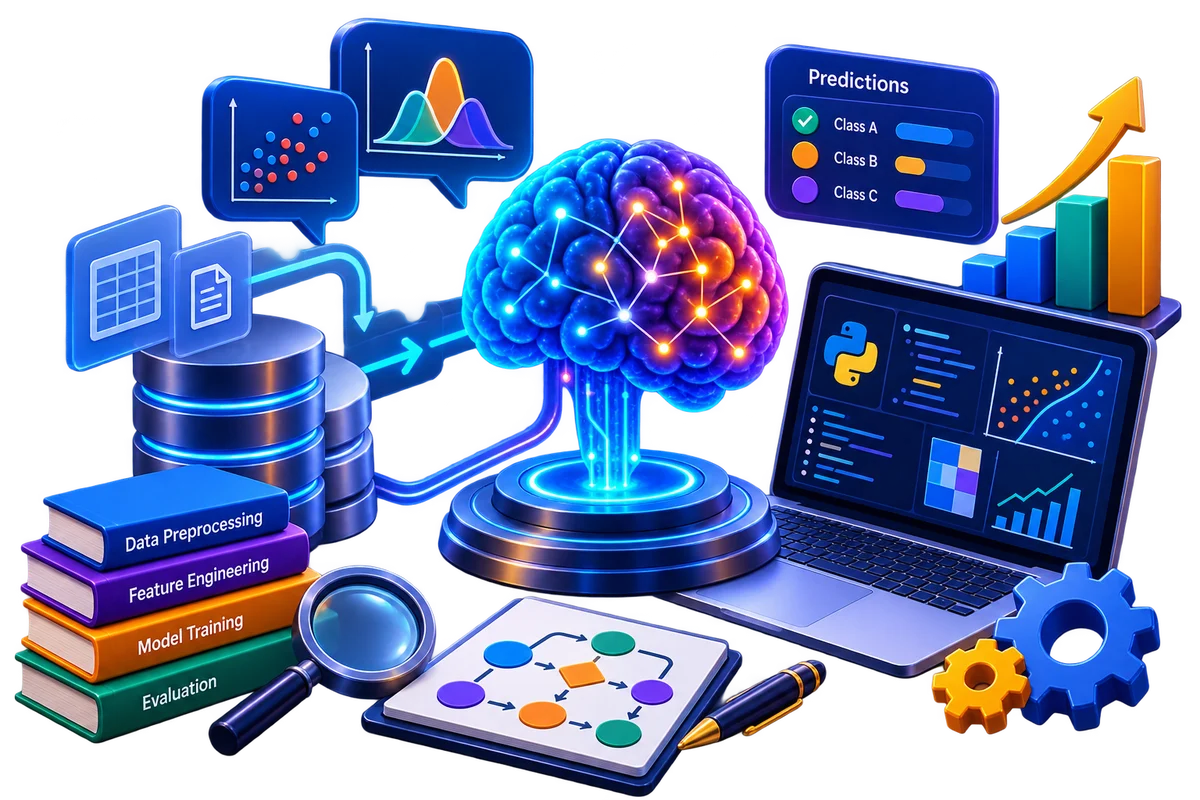
A machine learning pipeline — preprocessing, feature engineering, model training and evaluation around a trained model

Admissions open

Free demo class & counselling

Batch slots

  • Weekday
  • Evening
  • Weekend
Talk to a counsellor

Course overview

The machine learning and artificial intelligence certificate

Looking for the best Machine Learning and Artificial Intelligence course in Ludhiana? techcadd’s certificate program is built for students, graduates, and job seekers who want practical, industry-ready AI and ML skills — right here in Ludhiana, without needing to travel to Chandigarh, Delhi, or Bangalore for quality training.

This AI and ML certification course in Ludhiana covers Python programming, machine learning algorithms, deep learning, neural networks, NLP, and Generative AI tools — all taught through real projects and hands-on labs, not just theory. Whether you’re a fresher exploring AI courses after 12th, a graduate planning a career switch, or a working professional upskilling for better opportunities, the program is designed to take you from beginner to job-ready.

techcadd combines expert mentorship, live projects, placement assistance, and a curriculum aligned with current demand across the IT, healthcare, e-commerce, and FinTech sectors growing in the Ludhiana–Chandigarh region. By the end, students leave with a portfolio of real AI/ML projects, a recognised certificate, and the confidence to apply for roles like Machine Learning Engineer, AI Developer, and Data Analyst.
  • Every algorithm implemented before it is imported
  • Evaluation taught as seriously as training
  • Models deployed, not left in a notebook

Curriculum

A path from first steps to shipped work

5 modules and 29 topics across 4–5 months, in the order they are taught. Each one closes with something that works before the next one opens.

5 learning modules01 / 05
Module 01 · Weeks 1–3

Python, Data & Statistics

Loading, cleaning and understanding data before a single model is fitted.

Topics covered

  • Pandas operations
  • Data cleaning
  • Descriptive statistics
  • Distributions
  • Hypothesis testing
  • Visualisation

Tools & libraries

  • Python
  • Pandas
  • Seaborn
  • Jupyter

You finish with

An exploratory analysis of a messy real dataset with defensible conclusions.

Module 02 · Weeks 4–8

Supervised Learning

Regression and classification, from linear models to gradient boosting.

Topics covered

  • Linear & logistic regression
  • Decision trees
  • Random forests
  • Gradient boosting
  • SVMs
  • Regularisation

Tools & libraries

  • scikit-learn
  • XGBoost
  • LightGBM

You finish with

A benchmarked set of models on one problem, with a reasoned pick of the winner.

Module 03 · Weeks 9–12

Unsupervised Learning & Feature Engineering

Structure without labels, and the feature work that usually beats a fancier algorithm.

Topics covered

  • K-means & hierarchical clustering
  • PCA
  • Anomaly detection
  • Encoding strategies
  • Feature selection
  • Imbalanced data

Tools & libraries

  • scikit-learn
  • imbalanced-learn
  • UMAP

You finish with

A customer segmentation with clusters you can describe to a business audience.

Module 04 · Weeks 13–15

Evaluation & Model Selection

How models fail quietly, and the discipline that catches it before production does.

Topics covered

  • Cross-validation
  • Precision, recall & ROC
  • Leakage detection
  • Hyperparameter search
  • Calibration
  • Explainability

Tools & libraries

  • scikit-learn
  • Optuna
  • SHAP

You finish with

A model card documenting metrics, limitations and the features driving predictions.

Module 05 · Weeks 16–18

Deployment & Monitoring

Serving predictions, tracking experiments and noticing when a model goes stale.

Topics covered

  • Model serialisation
  • REST inference APIs
  • Experiment tracking
  • Batch vs real time
  • Drift monitoring

Tools & libraries

  • FastAPI
  • MLflow
  • Docker
  • Streamlit

You finish with

Your capstone model served through an API with tracked experiments behind it.

What you learn

The full curriculum, and the tools it covers

The course is structured as a progressive journey — starting from programming fundamentals and moving through to advanced AI concepts and real-world deployment. Here is exactly what you’ll cover.

  1. Python Programming for AI & ML

    Every strong AI/ML skillset starts with Python. You’ll learn Python syntax, data structures, functions, and the libraries essential for data science — including NumPy for numerical computing and Pandas for data manipulation and analysis. This foundation means students with zero prior coding experience can confidently move into advanced topics.

  2. Data Preprocessing & Exploratory Data Analysis

    Before any model can learn, data has to be cleaned and understood. You’ll learn how to handle missing values, detect outliers, normalise datasets, and use visualisation libraries like Matplotlib and Seaborn to explore patterns in real datasets — a critical, often underrated skill that employers specifically test for.

  3. Statistics & Mathematics for Machine Learning

    A practical rather than overly academic grounding in probability, statistics, linear algebra and calculus — just enough to genuinely understand how ML algorithms work under the hood, instead of treating them as black boxes.

  4. Core Machine Learning Algorithms

    You’ll work hands-on with supervised learning (linear and logistic regression, decision trees, random forest, support vector machines, k-nearest neighbours) and unsupervised learning (K-Means and hierarchical clustering, PCA). Each algorithm is taught through real project implementation using Scikit-learn.

  5. Model Evaluation & Optimization

    Learn how to evaluate model performance using accuracy, precision, recall, F1-score and confusion matrices, along with cross-validation, hyperparameter tuning, and handling overfitting and underfitting — the skills that separate a beginner from a job-ready ML practitioner.

  6. Deep Learning & Neural Networks

    Move into Artificial Neural Networks, Convolutional Neural Networks for image data, and Recurrent Neural Networks for sequential data, using TensorFlow and Keras. You’ll understand activation functions, forward and backward propagation, and how to build and train real deep learning models.

  7. Natural Language Processing Basics

    Learn how machines process human language — text preprocessing, tokenization, sentiment analysis, and an introduction to transformer-based models, giving you exposure to the technology behind chatbots and language models.

  8. Generative AI & Modern AI Tools

    Hands-on exposure to Generative AI concepts and the practical use of contemporary AI tools — prompt engineering, use cases in automation, and how generative models are being applied across industries.

  9. Real Datasets & Capstone Projects

    Throughout the course you’ll work with real-world datasets across finance, healthcare, retail and e-commerce, culminating in a capstone project you can showcase directly in interviews or add to a professional portfolio.

Tools and technologies covered

  • Python
  • NumPy & Pandas
  • Matplotlib & Seaborn
  • Scikit-learn
  • TensorFlow & Keras
  • Jupyter Notebook
  • SQL basics
  • Generative AI tools

By the end of this AI and ML certification course in Ludhiana, you won’t just understand AI and ML theoretically — you’ll have built and trained real models, giving you a practical skillset and a project portfolio ready for job applications.

Find your pace

What you can do, phase by phase

The Machine Learning syllabus in the order you meet it, and what you are able to do by the end of each stretch of it. Every row is a capability, not a topic you sat through.

Every capability in the Machine Learning syllabus, and the phase it is covered in
CapabilityFoundationsAppliedProfessional
Pandas operationsPython, Data & StatisticsCovered in FoundationsCovered in AppliedCovered in Professional
Data cleaningPython, Data & StatisticsCovered in FoundationsCovered in AppliedCovered in Professional
Descriptive statisticsPython, Data & StatisticsCovered in FoundationsCovered in AppliedCovered in Professional
DistributionsPython, Data & StatisticsCovered in FoundationsCovered in AppliedCovered in Professional
Hypothesis testingPython, Data & StatisticsCovered in FoundationsCovered in AppliedCovered in Professional
VisualisationPython, Data & StatisticsCovered in FoundationsCovered in AppliedCovered in Professional
Linear & logistic regressionSupervised LearningCovered in FoundationsCovered in AppliedCovered in Professional
Decision treesSupervised LearningCovered in FoundationsCovered in AppliedCovered in Professional
Random forestsSupervised LearningCovered in FoundationsCovered in AppliedCovered in Professional
Gradient boostingSupervised LearningCovered in FoundationsCovered in AppliedCovered in Professional
SVMsSupervised LearningCovered in FoundationsCovered in AppliedCovered in Professional
RegularisationSupervised LearningCovered in FoundationsCovered in AppliedCovered in Professional
K-means & hierarchical clusteringUnsupervised Learning & Feature EngineeringNot yet covered in FoundationsCovered in AppliedCovered in Professional
PCAUnsupervised Learning & Feature EngineeringNot yet covered in FoundationsCovered in AppliedCovered in Professional
Anomaly detectionUnsupervised Learning & Feature EngineeringNot yet covered in FoundationsCovered in AppliedCovered in Professional
Encoding strategiesUnsupervised Learning & Feature EngineeringNot yet covered in FoundationsCovered in AppliedCovered in Professional
Feature selectionUnsupervised Learning & Feature EngineeringNot yet covered in FoundationsCovered in AppliedCovered in Professional
Imbalanced dataUnsupervised Learning & Feature EngineeringNot yet covered in FoundationsCovered in AppliedCovered in Professional
Cross-validationEvaluation & Model SelectionNot yet covered in FoundationsCovered in AppliedCovered in Professional
Precision, recall & ROCEvaluation & Model SelectionNot yet covered in FoundationsCovered in AppliedCovered in Professional
Leakage detectionEvaluation & Model SelectionNot yet covered in FoundationsCovered in AppliedCovered in Professional
Hyperparameter searchEvaluation & Model SelectionNot yet covered in FoundationsCovered in AppliedCovered in Professional
CalibrationEvaluation & Model SelectionNot yet covered in FoundationsCovered in AppliedCovered in Professional
ExplainabilityEvaluation & Model SelectionNot yet covered in FoundationsCovered in AppliedCovered in Professional
Model serialisationDeployment & MonitoringNot yet covered in FoundationsNot yet covered in AppliedCovered in Professional
REST inference APIsDeployment & MonitoringNot yet covered in FoundationsNot yet covered in AppliedCovered in Professional
Experiment trackingDeployment & MonitoringNot yet covered in FoundationsNot yet covered in AppliedCovered in Professional
Batch vs real timeDeployment & MonitoringNot yet covered in FoundationsNot yet covered in AppliedCovered in Professional
Drift monitoringDeployment & MonitoringNot yet covered in FoundationsNot yet covered in AppliedCovered in Professional

The full programme runs 4–5 months. Where you finish is a question of pace rather than of syllabus — everyone covers all of it.

The case for it

Your months should build more than a certificate.

A course is worth the time you give it only if you finish with work you can show and skills you can defend. That is the standard this programme is designed against.

12+Practical learning areasfrom fundamentals to delivery
  • You learn machine learning the way it is used in production, with the workflow, tooling and standards a working team expects. Nothing in the syllabus exists only to fill hours.

  • Sessions are hands-on. You do every example, break it, and fix it. Each module closes with a lab task that has to work before you move on.

  • Five shipped finished projects — the kind of work an interviewer can open, click through and question you on.

  • A structured final phase: portfolio review, profile cleanup, aptitude and role-specific practice, mock interviews and placement support.

Why this course

Why should you choose this course?

Six things we hold ourselves to for every Machine Learning batch that starts in Ludhiana.

  • 01

    Industry-focused curriculum

    Syllabus built around what machine learning teams actually ship — no filler modules, no theory that never reaches your hands.

  • 02

    Practical learning

    Every concept lands in the tool the same day. You work in machine learning during each class, not just in your notes.

  • 03

    Real-world projects

    Build with real requirements, real data and real problems — from the first task to a finished, reviewable deliverable.

  • 04

    Mentor guidance

    Trainers who work with machine learning daily review your work, your logic and your approach line by line.

  • 05

    Career preparation

    Resume, portfolio, aptitude rounds and interview practice built into the last phase of the course.

  • 06

    Placement support

    Interview referrals, mock rounds and continued doubt support after the course ends.

Eligibility

Is this course right for you?

The Certificate Course in Machine Learning & Artificial Intelligence in Ludhiana is designed to be accessible to a wide range of learners — you don’t need to be a coding genius or a computer science topper to get started. If you have curiosity, basic logical thinking, and a willingness to learn, this course can work for you.

  • 12th Pass Students (Science & Commerce Background)

    If you’ve just finished your 12th and are exploring AI courses in Ludhiana after 12th, this is one of the smartest early career moves you can make. Students from Science (Non-Medical) backgrounds benefit from prior exposure to maths and basic computer concepts, but Commerce students with an interest in technology are equally welcome. Starting early means you enter the job market with practical AI/ML skills years ahead of peers who wait until after graduation to specialise.

    Start early
  • Undergraduate & Postgraduate Students

    Whether you’re pursuing B.Tech, BCA, B.Sc (IT/CS), MCA, or even a non-technical degree like B.Com or BBA, this Machine Learning certification course in Ludhiana is structured to help you build in-demand technical skills alongside your degree. Many colleges in and around Punjab don’t offer deep, practical AI/ML training as part of the regular curriculum — this course fills that exact gap with hands-on projects and real datasets.

    Alongside a degree
  • Fresh Graduates & Job Seekers

    If you’ve completed your degree and are struggling to find the right job in Ludhiana’s competitive market, a certified AI and ML program becomes a genuine differentiator. Recruiters across Ludhiana’s growing IT, manufacturing, and export sectors are looking for candidates who understand data-driven decision-making, automation, and AI tools — the skills this course builds directly.

    A differentiator
  • Working Professionals Looking to Upskill

    IT professionals, data entry specialists, software testers, or non-tech professionals working in Ludhiana’s textile, hosiery, auto-parts, or FinTech industries can use this course to pivot into AI/ML roles. Evening and weekend batch options make it practical to learn machine learning without quitting your current job.

    Evening batches
  • Entrepreneurs & Business Owners

    Understanding AI isn’t just for engineers anymore. Local business owners who want to apply AI for automation, customer insights, or predictive analytics in their own ventures will find real, applicable value here — enough to evaluate a vendor’s claims rather than take them on trust.

    Apply it yourself
  • Anyone Transitioning Careers into Tech

    If you’re from a non-IT background — arts, commerce, even a diploma — and want to break into AI, the program starts from the fundamentals of Python and basic statistics before moving into advanced ML and AI concepts, so no prior coding background is mandatory.

    No coding needed

What you actually need before day one

4–5 months · Classroom & online batches

  • A laptop or desktop — we help you set it up in the first session
  • A stable internet connection for the online batches
  • No prior coding or technical background
  • Basic English reading — the tools and their documentation are in English
  • About 6-8 hours a week outside class for practice
  • Willingness to finish the lab task before the next class

Basic eligibility: 12th pass in any stream, no mandatory coding background, and a genuine interest in technology, data and problem-solving. Basic computer literacy helps but is not essential. Ask about Machine Learning

Technology ecosystem

One discipline.
A mesh of real tools.

Machine Learning is the centre. These are the tools you use around it in a working team.

  • Core ML library
  • Gradient boosting
  • Data wrangling
  • Numerical computing
  • Model explainability
  • Experiment tracking
  • Serving predictions
  • Model demos
  • scikit-learnCore ML library
  • XGBoostGradient boosting
  • PandasData wrangling
  • NumPyNumerical computing
  • SHAPModel explainability
  • MLflowExperiment tracking
  • FastAPIServing predictions
  • StreamlitModel demos

Hands-on projects

Projects you actually ship,
not just follow along with.

Each one lands in your portfolio with the working files, the process and something a reviewer can open.

Capstone project

Customer Churn Prediction Engine

An end-to-end churn system on a real telecom dataset: leakage-safe feature engineering, class-imbalance handling, a benchmarked model set, SHAP explanations for every prediction, a retraining pipeline and a served API with drift alerts.

  • XGBoost
  • SHAP
  • MLflow
  • FastAPI
Difficulty
Advanced
Status
Portfolio ready
View project brief

Certification

Get certified in Machine Learning

A verifiable techcadd Machine Learning certificate, an internship letter for the project phase, and models you trained on real data with the evaluation written up honestly — including what did not work, which is the part interviewers probe.

  • Course completion certificate

    Issued in your name on completion of the Machine Learning syllabus, with a reference number an employer can verify with us.

  • Project certificate

    A separate certificate for the capstone you submit, naming the project so the work is attached to the credential.

  • Internship letter

    Students who complete the live-project phase receive an internship letter covering the duration and the work delivered.

  • Portfolio you own

    Every file, repository and deployed link stays yours — the part of the credential a reviewer can actually open.

techcadd has been training in Ludhiana since 2007. The certificate carries that record; the machine learning work you did carries the rest.

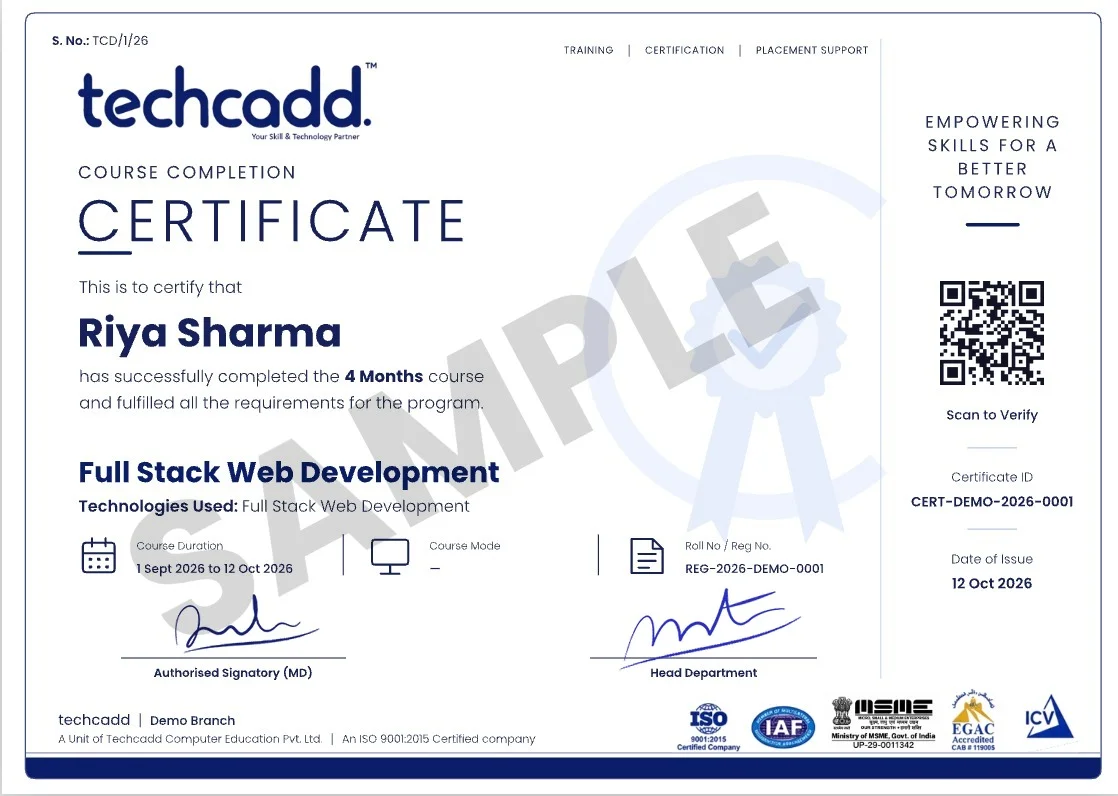
Sample techcadd course completion certificate
Course completion
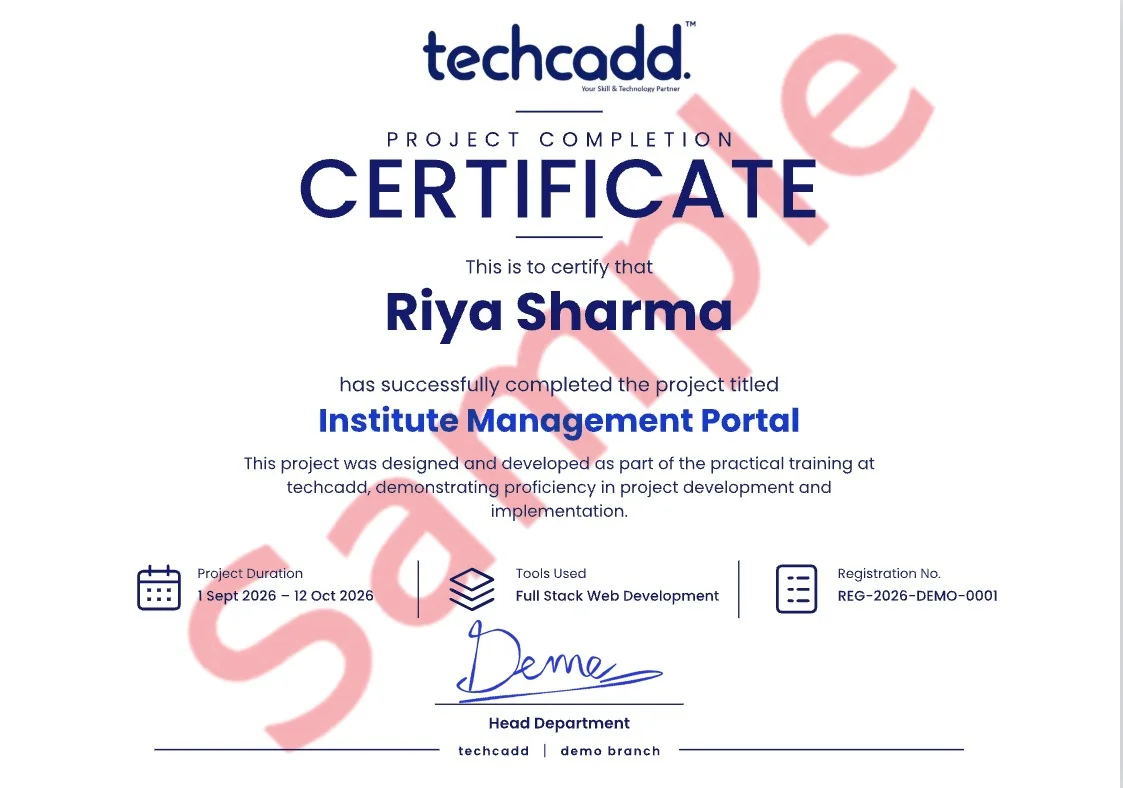
Sample techcadd project completion certificate
Project & internship

Where it takes you

Where this course takes you

The route from your first module to the roles Machine Learning opens — and the work that has to exist at each step.

  1. 01Learning
  2. 02Projects
  3. 03Portfolio
  4. 04Industry readiness
  5. 05Career opportunities
  • Machine Learning Engineer

    Build and maintain the models a product depends on.

  • Data Scientist

    Frame business problems as models and defend the results.

  • ML Ops Engineer

    Own pipelines, retraining and monitoring in production.

  • Applied Scientist

    Take research techniques and make them work on real data.

  • Risk / Fraud Analyst

    Apply models to detection problems in finance and operations.

  • AI Engineer

    Extend into deep learning and generative systems.

Salary outlook

What machine learning pays in Ludhiana and beyond

Indicative ranges for the roles a **machine learning course in Ludhiana** opens, across the three markets that realistically hire from Punjab.

Indicative annual packages by role and market
RoleLudhiana & PunjabDelhi NCR & BengaluruRemote & freelance
Machine Learning EngineerEntry₹3.0–5.5 LPA₹5.5–12 LPA₹40k–1.1L / project
Data ScientistEntry to mid₹3.6–6.5 LPA₹7–16 LPA₹50k–1.5L / project
Data AnalystEntry₹2.4–4.5 LPA₹4–9 LPA₹25k–70k / project
ML EngineerMid (2–4 yrs)₹6–11 LPA₹12–25 LPA₹1L–2.8L / project

Ranges are indicative, drawn from what our own students report and from openings we see through the placement cell. Actual offers depend on your portfolio, the interview and the company — nobody can promise you a number, and we do not.

  • Machine learning engineer, data scientist, data analyst, ML associate and — where the work is more applied than statistical — AI developer. In Punjab the first role usually combines analysis and modelling rather than separating them.

  • The first two years are about proving you can take a model past the notebook. Students who learn deployment, monitoring and honest evaluation move up noticeably faster than those who stop at accuracy scores.

  • Yes. ML work is reviewed on repositories and results, both of which travel. Freelance work from Punjab is typically forecasting, classification and dashboard-plus-model builds for small and mid-sized businesses.

  • Manufacturing and auto-components around Ludhiana using predictive maintenance and quality inspection, hosiery and textile exporters on demand forecasting, agri-tech near PAU, hospitals and diagnostics, logistics, banking and finance offices, and IT services firms. Mohali and Chandigarh add product teams.

  • Directly useful for an M.Tech, MCA or a data-science masters abroad. The projects give you the applied half that most applicants from Punjab cannot show, and the evaluation write-ups transfer straight into a dissertation.

Why this programme

Why this program makes sense right now

Ludhiana has long been Punjab’s industrial and business capital — hosiery, textiles, auto parts, manufacturing. But the city’s economy is shifting. IT parks, FinTech startups, e-commerce operations and tech-enabled manufacturing are growing across the Punjab–Chandigarh corridor, and every one of those sectors is hiring people who understand AI and machine learning. This program exists to put Ludhiana’s students directly into that pipeline, without relocating.

  1. AI & ML Are No Longer Optional Skills

    Across banking, healthcare, retail, manufacturing and logistics, AI and ML are becoming core to how businesses operate. Companies aren’t just hiring “AI specialists” anymore — they expect marketing teams, analysts and even operations staff to understand automation and data-driven tools. This course makes sure you’re not left behind as that shift accelerates.

  2. Real, Practical, Project-Based Learning

    Unlike purely theoretical programs, this course is built around live projects, real datasets, and practical implementation using Python, TensorFlow and industry-standard ML frameworks. You don’t just learn what a neural network is — you build one. That hands-on work is what employers actually screen for in interviews.

  3. Certification That Adds Real Value

    A recognised machine learning and AI certificate signals that you completed structured, verified training rather than a few scattered tutorials. That matters when you’re competing against candidates from bigger cities for the same remote or hybrid roles — though what carries the interview is the project work behind it.

  4. Career Flexibility Across Multiple Roles

    This program doesn’t lock you into one narrow job title. Graduates can pursue Machine Learning Engineer, AI Developer, Data Analyst, Python Developer, Business Intelligence Analyst and Automation Specialist roles — multiple entry points into tech from Ludhiana itself, or remotely for companies across India and beyond.

  5. Local Access, Global Relevance

    You get a machine learning training centre in Ludhiana with mentors who understand both global AI trends and the local job market — including which skills recruiters at Punjab’s IT and manufacturing-tech companies are actually asking for. That local-plus-global balance is hard to find in generic online-only courses.

  6. Early-Mover Advantage in a Growing Market

    AI and ML talent in tier-2 cities like Ludhiana is still relatively limited compared with the metros, which means less competition for those who train now. Students who complete this certificate today are positioning themselves ahead of a talent wave that will only get more competitive.

  7. Support Beyond Just Classes

    Beyond the curriculum, the program includes mentorship, doubt-clearing sessions, resume building, interview preparation and placement assistance — designed to help students move from classroom learning to actual job offers.

Not just another certificate — a structured, locally-accessible pathway into one of the fastest-growing career fields in tech, built for where you already are.

Why techcadd

Why choose techcadd

With multiple institutes across Ludhiana claiming to offer AI and machine learning training, choosing can feel overwhelming. Here is what actually sets this one apart.

  1. Ludhiana-Based, Locally Accessible Training Centre

    techcadd operates directly out of Ludhiana, so you don’t have to commute to Chandigarh or rely purely on generic online courses with no local support. You get face-to-face mentorship, in-person doubt-clearing, and a learning environment built around the needs of Ludhiana’s student and job-seeker community.

  2. Curriculum Built for Real Industry Demand

    This isn’t a copy-paste theoretical syllabus. It’s structured around what recruiters are actually asking for — Python for ML, supervised and unsupervised learning, deep learning with TensorFlow and Keras, NLP fundamentals, and exposure to Generative AI tools. Every module is designed to translate into resume-ready, interview-ready skills.

  3. Hands-On, Project-Based Learning Approach

    Rather than passive lectures, the emphasis is on live projects and real datasets from day one. Students build classification models, prediction systems and AI-powered mini-projects they can actually showcase to employers or include in a portfolio.

  4. Experienced Trainers with Industry Exposure

    Instructors bring practical, industry-relevant experience rather than academic knowledge alone. Class discussions go beyond textbook definitions into how AI and ML are actually applied in FinTech, healthcare, e-commerce and manufacturing-tech — exactly the context that helps students perform in real interviews.

  5. Beginner-Friendly Yet Career-Focused

    The program is deliberately structured so students with zero coding background aren’t left behind, while still going deep enough that graduates and working professionals get real technical depth. That dual approach makes it accessible without being shallow.

  6. Placement Assistance & Career Support

    Beyond teaching the technology, techcadd supports students with resume building, interview preparation and placement assistance — bridging the gap between completing a course and landing a job.

  7. Flexible Batch Timings

    Students, graduates and working professionals all have different schedules, so weekday, weekend and evening batch options let the course fit around your existing commitments rather than the other way around.

  8. Recognised Certification

    On completion, students receive a certificate that validates their training to recruiters — a useful trust signal, particularly when applying to companies outside Punjab who may not know local institutes but do recognise structured, verifiable credentials.

  9. Strong Local Reputation & Track Record

    techcadd has built a name among Ludhiana’s student community as a serious, results-oriented training institute rather than another coaching centre. Word-of-mouth referrals and students returning for advanced courses are the clearest signal of consistent quality.

Local accessibility, a practical curriculum, experienced mentorship and genuine placement support — a strong combination for anyone serious about starting an AI and machine learning career from Ludhiana.

Future scope

The road ahead for machine learning

A course ends; the field does not. Here is the honest version of what the next few years look like for machine learning — where the roles go, and what is shifting underneath them while you learn.

  1. Year 0–1

    Get in on proof of work

    Entry roles such as Machine Learning Engineer open as soon as you have projects that run. At this stage nobody is asking about your marks — they are asking you to walk through something you built.

  2. Year 2–4

    Specialise and get paid for it

    The generalists plateau; the specialists do not. Depth in one part of machine learning — the part your first job leans on hardest — is what moves you towards data scientist work.

  3. Year 5+

    Own the decisions

    Architecture, standards, hiring and mentoring. The technical skill is assumed by now; what you are paid for is judgement, and judgement only comes from having shipped things that mattered.

Sectors hiring for this skill set

  • IT services
  • Product startups
  • Banking & fintech
  • Healthcare
  • E-commerce
  • Manufacturing
  • EdTech
  • Government & PSUs

The comparison

Why students pick techcadd for Machine Learning

Every institute in Ludhiana claims industry training and placement support. These are the differences you can actually check on a demo visit — ask any of them of anyone, including us.

techcadd compared with a typical institute, feature by feature
What to ask abouttechcaddTypical institute
Who teachesTrainers who still do machine learning work outside the classroomFull-time faculty teaching from a fixed deck
1-on-1 classesOne-to-one teaching available on every course — the pace is yours, and your work is looked at by nameOne group class moving at one pace, whoever that pace happens to suit
Project work5 real projects plus a capstone you deploy and defendGuided exercises copied from the board
CurriculumReviewed every batch against what working teams shipUpdated when the printed syllabus is reprinted
How a module endsA lab task that has to run before you move onNotes to revise before an exam
Doubt supportTrainer sits with your code; open lab hours between classesAsk at the end of class if there is time left
What you leave withCompletion certificate, project certificate, internship letter — all verifiableOne printed certificate
After the coursePortfolio review, mock interviews, referrals, continued doubt supportThe course ends and so does the contact

Written about the market, not about any particular institute in it. Visit two or three, sit through a demo class at each, and ask all eight of these questions — that is the only version of this table worth trusting.

Student Voices

What Machine Learning learners say

Feedback from students who completed the Machine Learning programme at techcadd Ludhiana.

Google Reviews4.8from 181 Google reviewsGoogle Verified
SK

Simranjeet Kaur

Machine Learning / B.Sc. IT graduate

I joined with no background in this. By the third month I was building machine learning work on my own, and the project reviews are where I actually learnt to do it properly.

Posted on Google
HS

Harman Sethi

Machine Learning / Now working as an intern in the field

The classes are practical. Every session ends with a task that has to work, so you cannot fake understanding. That habit helped me most in interviews.

Posted on Google
AV

Ankit Verma

Machine Learning / BCA final year

Doubt support was the difference for me. My trainer sat with my work, found the mistake and made me fix it myself instead of handing over the answer.

Posted on Google
NS

Navjot Singh

Machine Learning / Career switch from operations

I came for the skill and left with a portfolio — projects I could actually demo on a call, not a certificate I had to explain.

Posted on Google

Real, unedited feedback from techcadd learners on Google.

Frequently asked questions

Questions before you enrol

The 15 things people ask most often about the Machine Learning course at techcadd Ludhiana.

  • A Machine Learning Course in Ludhiana teaches students how to use programming, data, statistics, and algorithms to develop systems that identify patterns and make predictions from data. A practical course covers Python, data preprocessing, supervised and unsupervised learning, model evaluation, and machine learning projects.

  • Students, graduates, job seekers, working professionals, and aspiring AI or data science learners can consider a Machine Learning course. Beginners can start with foundational programming and data concepts before progressing to algorithms.

  • Machine Learning can seem challenging initially because it combines programming, mathematics, statistics, and problem-solving. A structured course that starts with Python and fundamentals makes the process far more manageable for beginners.

  • Prior programming experience helps, but beginners can learn the required Python fundamentals as part of a structured learning path. Regular coding practice is what builds confidence.

  • Python is one of the most widely used languages for Machine Learning, because of its extensive ecosystem of libraries and tools for data analysis, modelling, and AI development.

  • Depending on the curriculum, students work with Python, NumPy, Pandas, Matplotlib, Seaborn, Scikit-learn, Jupyter Notebook, Google Colab, SQL, Git/GitHub, and potentially TensorFlow or PyTorch for advanced topics.

  • A comprehensive curriculum includes Python, statistics fundamentals, data preprocessing, exploratory data analysis, supervised learning, unsupervised learning, feature engineering, model evaluation, model improvement, and practical projects. Advanced programs may also introduce Deep Learning, NLP, Computer Vision, and Generative AI.

  • Yes. College students can use Machine Learning training to strengthen practical skills, work on academic projects, prepare for internships, and build a portfolio. It complements formal education in computer science, IT, engineering, mathematics, or related fields.

  • Yes. Graduates from technical, analytical, mathematics, statistics, engineering, and related backgrounds can build relevant skills. Learners from non-technical backgrounds may need additional time to develop the programming and mathematical foundations.

  • Machine Learning skills support exploration of machine learning development, data science, AI development, data analytics, predictive analytics, and related technology roles. Actual opportunities depend on a learner’s skills, projects, qualifications, experience, and individual employer requirements.

  • Yes. Projects let students apply data preprocessing, feature engineering, model training, and evaluation to practical problems, and provide portfolio material that demonstrates hands-on ability.

  • Compare the curriculum, practical training, project exposure, trainer expertise, tools covered, learning support, class format, course duration, and overall learning objectives. Verify current course details and reviews before enrolling.

  • Yes. Machine Learning provides an important foundation for advanced AI. After developing ML fundamentals, learners can progress toward Deep Learning, Natural Language Processing, Computer Vision, Generative AI, and other specialised areas.

  • No. Artificial Intelligence is the broader field of creating systems that perform tasks associated with intelligent behaviour. Machine Learning is a major approach within AI that enables systems to learn patterns from data.

  • That depends on your existing programming knowledge, the course structure, your practice schedule, and your goals. Beginners generally need consistent practice over time to develop both conceptual understanding and practical coding skill.

Talk to our experts

Start your Machine Learning journey

Ready to learn Machine Learning in Ludhiana? Build practical skills in Python, data analysis, machine learning algorithms, model development and AI fundamentals — whether you are a 12th-pass student, graduate, job seeker, college student, or working professional.

  • CourseMachine Learning Course
  • Duration4–5 months
  • ModeClassroom & online batches
  • Centretechcadd Ludhiana

Would rather talk now? +91 98881 22667

Taken from the page you are on — this enquiry reaches the Machine Learning counsellor directly.

Loading the security check…

We never share your number. Expect a call within working hours.

Ready to get started?

Start building your career today.

Talk to a counsellor today. One call is usually enough to know which track fits your degree, your schedule and the job you want.

Call now+91 98881 22667
  • Free career counselling
  • No registration fee
  • Placement support included
InternshipJoin