Neural networks, properly understood

Build networks.Know why they work.

CNNs, RNNs, transformers and generative models in PyTorch — with the training craft that turns an architecture diagram into a model that actually converges.

 4–5 monthsClassroom & online batchesBeginner to job ready
Explore course
4.8/5
Student rating
500+
Students trained
6+
Industry projects
Yes
Placement support
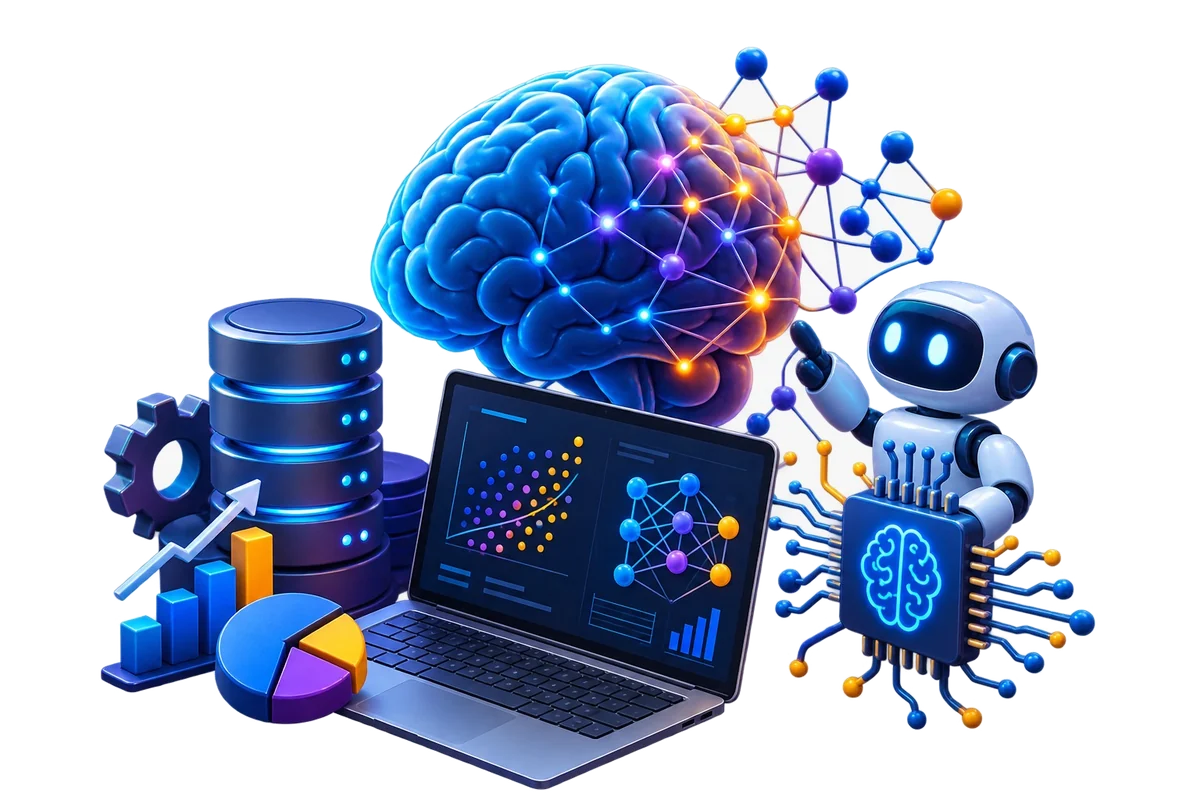
A neural network rendered as a lit brain beside a training notebook, a database stack, a chip and a robot

Admissions open

Free demo class & counselling

Batch slots

  • Weekday
  • Evening
  • Weekend
Talk to a counsellor

Course overview

Machine learning and deep learning, taught in Ludhiana

Looking for a professional certificate course in Machine Learning & Deep Learning in Ludhiana that actually gets you job-ready? techcadd’s ML & Deep Learning program is built for students and professionals who want to break into India’s fastest-growing tech field without relocating to Chandigarh, Delhi, or Bangalore.

This isn’t another theory-heavy course. You’ll work with real datasets, build neural networks from scratch, and deploy live AI projects — covering everything from Python and statistics to CNNs, RNNs, NLP, and Generative AI. Whether you’re a 12th-pass student exploring career options, a B.Tech/BCA/MCA graduate, or a working professional looking to upskill, this certificate program is designed to match current industry hiring standards.

With hands-on training, portfolio-ready projects, and placement support based right here in Ludhiana, techcadd bridges the gap between classroom learning and real AI job roles at MNCs, startups, and IT companies across Punjab and beyond.
  • Backpropagation written by hand before any framework
  • GPU training with real datasets
  • Transformers built from their components

Curriculum

A path from first steps to shipped work

5 modules and 29 topics across 4–5 months, in the order they are taught. Each one closes with something that works before the next one opens.

5 learning modules01 / 05
Module 01 · Weeks 1–3

Foundations & Autograd

Tensors, gradients and a neural network written from first principles in NumPy.

Topics covered

  • Tensor operations
  • Chain rule
  • Manual backpropagation
  • Loss functions
  • Optimisers

Tools & libraries

  • NumPy
  • PyTorch
  • Jupyter

You finish with

A two-layer network you wrote without a framework, matching PyTorch on the same data.

Module 02 · Weeks 4–7

Training Deep Networks

The practical craft: initialisation, normalisation, schedules and reading a training curve.

Topics covered

  • Weight initialisation
  • Batch normalisation
  • Dropout
  • Learning-rate schedules
  • Early stopping
  • Debugging training

Tools & libraries

  • PyTorch
  • TensorBoard
  • CUDA

You finish with

A stable training setup with logged experiments and a curve you can diagnose.

Module 03 · Weeks 8–11

Computer Vision Architectures

Convolutions, residual networks, augmentation and transfer learning.

Topics covered

  • CNN design
  • ResNet & EfficientNet
  • Data augmentation
  • Transfer learning
  • Segmentation
  • Detection heads

Tools & libraries

  • PyTorch
  • torchvision
  • Albumentations

You finish with

A fine-tuned vision model beating a from-scratch baseline on your own dataset.

Module 04 · Weeks 12–15

Sequences & Transformers

From RNNs to self-attention, built up component by component.

Topics covered

  • RNN & LSTM
  • Embeddings
  • Self-attention
  • Positional encoding
  • Encoder-decoder
  • Fine-tuning

Tools & libraries

  • PyTorch
  • Hugging Face
  • tokenizers

You finish with

A transformer block written from scratch, then a fine-tuned pretrained model.

Module 05 · Weeks 16–18

Generative Models & Deployment

Autoencoders, GANs and diffusion intuition — then serving a model efficiently.

Topics covered

  • Autoencoders
  • GAN training
  • Diffusion basics
  • Quantisation
  • ONNX export
  • Inference serving

Tools & libraries

  • PyTorch
  • ONNX
  • FastAPI
  • Gradio

You finish with

A generative capstone with a live demo interface anyone can try.

What you learn

What you’ll learn and the tools you’ll work with

The syllabus runs from the foundations every ML professional needs through to the deep learning architectures behind today’s most advanced AI systems — each stage reinforced by a project rather than a slide deck.

  1. Core Machine Learning Foundations

    You’ll start with the building blocks: Python programming for data science, statistics and probability, data preprocessing, and exploratory data analysis. From there you move into the core algorithms — linear and logistic regression, decision trees, random forests, support vector machines, k-nearest neighbours, and clustering techniques like K-Means. You’ll also cover model evaluation (accuracy, precision, recall, F1-score, cross-validation), so you understand not just how to build models but how to judge whether they actually work.

  2. Deep Learning & Neural Networks

    Once the ML fundamentals are solid, the course moves into deep learning — Artificial Neural Networks, Convolutional Neural Networks for image and computer vision tasks, and Recurrent Neural Networks and LSTMs for sequential and time-series data. You’ll also get an introduction to Transformer architectures, which power today’s most advanced AI systems and the tools built on them.

  3. Natural Language Processing

    A dedicated module covers NLP fundamentals — text preprocessing, sentiment analysis, tokenization, and building basic language models. This is increasingly relevant as more companies look to automate customer support, content moderation, and text analytics.

  4. Generative AI Exposure

    Given how fast the field is evolving, the course includes practical exposure to Generative AI concepts and tools — prompt-based systems, generative models, and how modern AI tools are being integrated into real business workflows, including Ludhiana’s textile, manufacturing, and IT sectors.

  5. Real-World Projects You’ll Build

    By the end of the program you’ll have built an image classification model using CNNs, a movie or product recommendation system, a sentiment analysis tool for customer reviews, a predictive analytics model such as sales or demand forecasting — directly relevant to Ludhiana’s manufacturing and retail businesses — and a basic chatbot or NLP text tool.

  6. Career-Ready Skill Set

    Beyond the technical syllabus, you build what recruiters actually look for: how to structure an ML project end to end, how to document and present your work, and how to talk about your projects confidently in an interview. That combination of technical depth and real project experience is what positions graduates for roles like Machine Learning Engineer, Data Analyst, AI Developer, and Junior Data Scientist.

Tools and technologies you’ll work with

  • Python
  • NumPy & Pandas
  • Matplotlib & Seaborn
  • Scikit-learn
  • TensorFlow & Keras
  • PyTorch
  • Jupyter / Google Colab
  • SQL
  • Git & GitHub
  • OpenCV
  • NLTK

Certificates alone don’t get you hired — a portfolio does. Everything above is sequenced so that what you finish with is a GitHub-ready set of projects you can hand to a recruiter, not a list of topics you have seen.

Find your pace

What you can do, phase by phase

The Deep Learning syllabus in the order you meet it, and what you are able to do by the end of each stretch of it. Every row is a capability, not a topic you sat through.

Every capability in the Deep Learning syllabus, and the phase it is covered in
CapabilityFoundationsAppliedProfessional
Tensor operationsFoundations & AutogradCovered in FoundationsCovered in AppliedCovered in Professional
Chain ruleFoundations & AutogradCovered in FoundationsCovered in AppliedCovered in Professional
Manual backpropagationFoundations & AutogradCovered in FoundationsCovered in AppliedCovered in Professional
Loss functionsFoundations & AutogradCovered in FoundationsCovered in AppliedCovered in Professional
OptimisersFoundations & AutogradCovered in FoundationsCovered in AppliedCovered in Professional
Weight initialisationTraining Deep NetworksCovered in FoundationsCovered in AppliedCovered in Professional
Batch normalisationTraining Deep NetworksCovered in FoundationsCovered in AppliedCovered in Professional
DropoutTraining Deep NetworksCovered in FoundationsCovered in AppliedCovered in Professional
Learning-rate schedulesTraining Deep NetworksCovered in FoundationsCovered in AppliedCovered in Professional
Early stoppingTraining Deep NetworksCovered in FoundationsCovered in AppliedCovered in Professional
Debugging trainingTraining Deep NetworksCovered in FoundationsCovered in AppliedCovered in Professional
CNN designComputer Vision ArchitecturesNot yet covered in FoundationsCovered in AppliedCovered in Professional
ResNet & EfficientNetComputer Vision ArchitecturesNot yet covered in FoundationsCovered in AppliedCovered in Professional
Data augmentationComputer Vision ArchitecturesNot yet covered in FoundationsCovered in AppliedCovered in Professional
Transfer learningComputer Vision ArchitecturesNot yet covered in FoundationsCovered in AppliedCovered in Professional
SegmentationComputer Vision ArchitecturesNot yet covered in FoundationsCovered in AppliedCovered in Professional
Detection headsComputer Vision ArchitecturesNot yet covered in FoundationsCovered in AppliedCovered in Professional
RNN & LSTMSequences & TransformersNot yet covered in FoundationsCovered in AppliedCovered in Professional
EmbeddingsSequences & TransformersNot yet covered in FoundationsCovered in AppliedCovered in Professional
Self-attentionSequences & TransformersNot yet covered in FoundationsCovered in AppliedCovered in Professional
Positional encodingSequences & TransformersNot yet covered in FoundationsCovered in AppliedCovered in Professional
Encoder-decoderSequences & TransformersNot yet covered in FoundationsCovered in AppliedCovered in Professional
Fine-tuningSequences & TransformersNot yet covered in FoundationsCovered in AppliedCovered in Professional
AutoencodersGenerative Models & DeploymentNot yet covered in FoundationsNot yet covered in AppliedCovered in Professional
GAN trainingGenerative Models & DeploymentNot yet covered in FoundationsNot yet covered in AppliedCovered in Professional
Diffusion basicsGenerative Models & DeploymentNot yet covered in FoundationsNot yet covered in AppliedCovered in Professional
QuantisationGenerative Models & DeploymentNot yet covered in FoundationsNot yet covered in AppliedCovered in Professional
ONNX exportGenerative Models & DeploymentNot yet covered in FoundationsNot yet covered in AppliedCovered in Professional
Inference servingGenerative Models & DeploymentNot yet covered in FoundationsNot yet covered in AppliedCovered in Professional

The full programme runs 4–5 months. Where you finish is a question of pace rather than of syllabus — everyone covers all of it.

The case for it

Your months should build more than a certificate.

A course is worth the time you give it only if you finish with work you can show and skills you can defend. That is the standard this programme is designed against.

12+Practical learning areasfrom fundamentals to delivery
  • You learn deep learning the way it is used in production, with the workflow, tooling and standards a working team expects. Nothing in the syllabus exists only to fill hours.

  • Sessions are hands-on. You do every example, break it, and fix it. Each module closes with a lab task that has to work before you move on.

  • Five shipped finished projects — the kind of work an interviewer can open, click through and question you on.

  • A structured final phase: portfolio review, profile cleanup, aptitude and role-specific practice, mock interviews and placement support.

Why this course

Why should you choose this course?

Six things we hold ourselves to for every Deep Learning batch that starts in Ludhiana.

  • 01

    Industry-focused curriculum

    Syllabus built around what deep learning teams actually ship — no filler modules, no theory that never reaches your hands.

  • 02

    Practical learning

    Every concept lands in the tool the same day. You work in deep learning during each class, not just in your notes.

  • 03

    Real-world projects

    Build with real requirements, real data and real problems — from the first task to a finished, reviewable deliverable.

  • 04

    Mentor guidance

    Trainers who work with deep learning daily review your work, your logic and your approach line by line.

  • 05

    Career preparation

    Resume, portfolio, aptitude rounds and interview practice built into the last phase of the course.

  • 06

    Placement support

    Interview referrals, mock rounds and continued doubt support after the course ends.

Eligibility

Who can do this course

One of the biggest questions students in Ludhiana ask before enrolling in any AI course is simple: “Am I even eligible?” The good news — this Machine Learning & Deep Learning certificate is designed with flexible entry points, so students from multiple academic backgrounds and career stages can join and succeed.

  • 12th Pass Students (Science & Commerce Background)

    If you’ve just finished your 12th and you’re looking for a future-focused career path instead of the usual B.Com or generic BA route, this course is a strong starting point. Students with a science background — especially Maths — often have a natural edge, but even commerce students with basic computer literacy can start here. Early exposure to ML and AI gives you a real head start before college, and many students use this certificate to strengthen their B.Tech or BCA admission profile around Ludhiana, Jalandhar, and Chandigarh.

    Head start
  • Graduates (B.Tech, BCA, MCA, B.Sc IT, B.Sc CS)

    This is the core audience. If you’ve completed a degree in Computer Science, IT, Electronics, or a related engineering stream from a college in or around Ludhiana, you already have the technical foundation. What you often lack is practical, project-based AI skill-building — and that is exactly what this course fills in. Fresh graduates who complete it become significantly more competitive for data science, ML engineer, and AI developer roles in both local IT firms and remote-first companies.

    Core audience
  • Non-CS Graduates Looking to Switch Careers

    You don’t need a computer science degree to succeed in ML. Students from mechanical, electrical, textile, or even non-technical degrees — common in Ludhiana given the city’s industrial and textile-manufacturing base — are increasingly moving into tech careers. The course starts with foundational Python and statistics before moving into advanced ML and DL concepts, so career switchers aren’t left behind.

    No CS degree needed
  • Working Professionals & IT Employees Seeking Upskilling

    Ludhiana has a growing base of software developers, data analysts, and IT support professionals working in local companies and remote MNC roles. If you’re already employed but want to move into AI and ML, this certificate offers weekend and evening batch flexibility so you can upskill without quitting your job.

    Weekend batches
  • Entrepreneurs & Business Owners in Ludhiana’s Industrial Sectors

    Ludhiana is known for hosiery, auto-parts manufacturing, and textiles. Business owners in these sectors are increasingly exploring AI-driven automation, demand forecasting, and predictive analytics. Understanding ML fundamentals helps decision-makers evaluate and implement AI tools in their own businesses rather than taking a vendor’s word for it.

    Evaluate AI yourself
  • Career Gap or Non-Working Individuals Wanting a Tech Restart

    If you’ve taken a break from studies or work and are looking for a high-demand skill to restart your career, ML and Deep Learning is one of the strongest options in today’s job market — and Ludhiana-based classroom support makes the transition easier than self-paced online learning alone.

    Restart here

What you actually need before day one

4–5 months · Classroom & online batches

  • A laptop or desktop — we help you set it up in the first session
  • A stable internet connection for the online batches
  • Basic Python and comfort with school-level maths. The course rebuilds the linear algebra and calculus you need as it goes.
  • Basic English reading — the tools and their documentation are in English
  • About 6-8 hours a week outside class for practice
  • Willingness to finish the lab task before the next class

No prior coding experience is required. The course starts with Python fundamentals and statistics before progressing to advanced machine learning and deep learning concepts, which is what makes it workable for complete beginners as well as graduates. Ask about Deep Learning

Technology ecosystem

One discipline.
A mesh of real tools.

Deep Learning is the centre. These are the tools you use around it in a working team.

  • Primary framework
  • Production alternative
  • Pretrained models
  • Vision datasets & models
  • Training visualisation
  • Portable inference
  • GPU acceleration
  • Model demos
  • PyTorchPrimary framework
  • TensorFlowProduction alternative
  • Hugging FacePretrained models
  • torchvisionVision datasets & models
  • TensorBoardTraining visualisation
  • ONNXPortable inference
  • CUDAGPU acceleration
  • GradioModel demos

Hands-on projects

Projects you actually ship,
not just follow along with.

Each one lands in your portfolio with the working files, the process and something a reviewer can open.

Capstone project

Medical Image Segmentation

A U-Net trained to segment scans, with heavy augmentation, class-imbalance handling, mixed-precision GPU training, ablation experiments and a Gradio demo. You justify every architectural choice against a measured baseline.

  • PyTorch
  • U-Net
  • CUDA
  • Gradio
Difficulty
Advanced
Status
Portfolio ready
View project brief

Certification

Get certified in Deep Learning

A verifiable techcadd Deep Learning certificate, an internship letter for the project phase, and trained models with their evaluation written up honestly — including the runs that did not work, which is the part a technical panel probes.

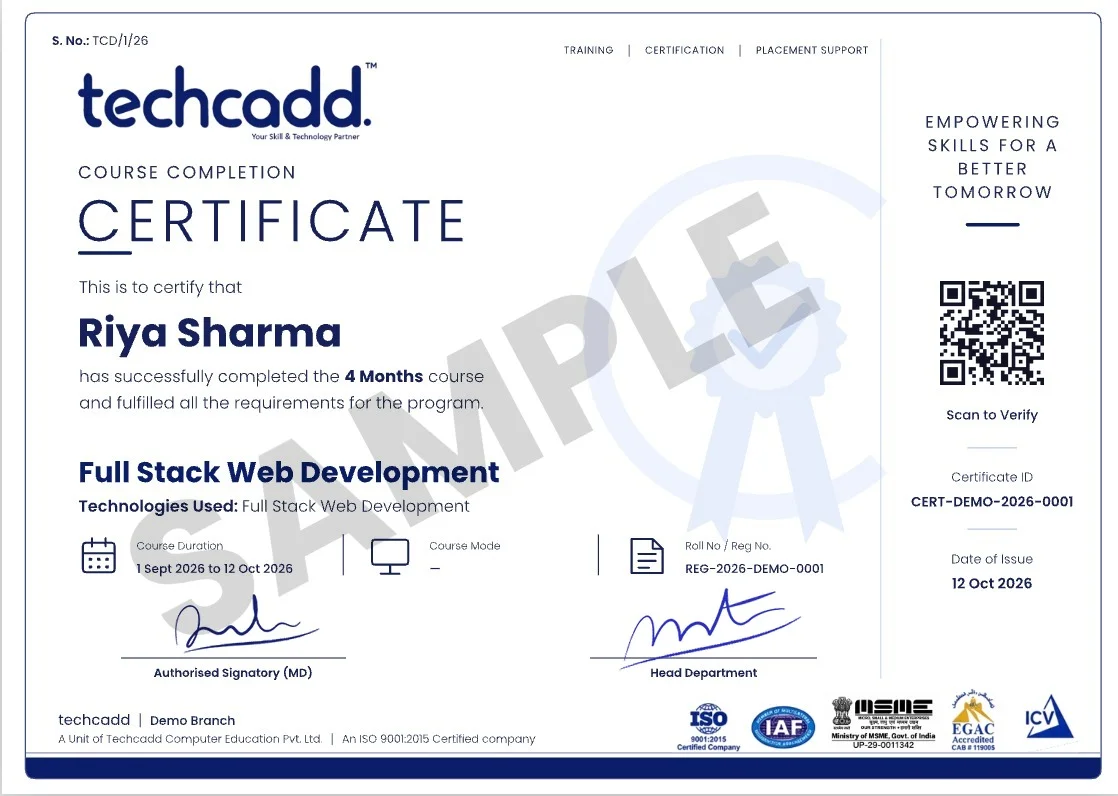
  • Course completion certificate

    Issued in your name on completion of the Deep Learning syllabus, with a reference number an employer can verify with us.

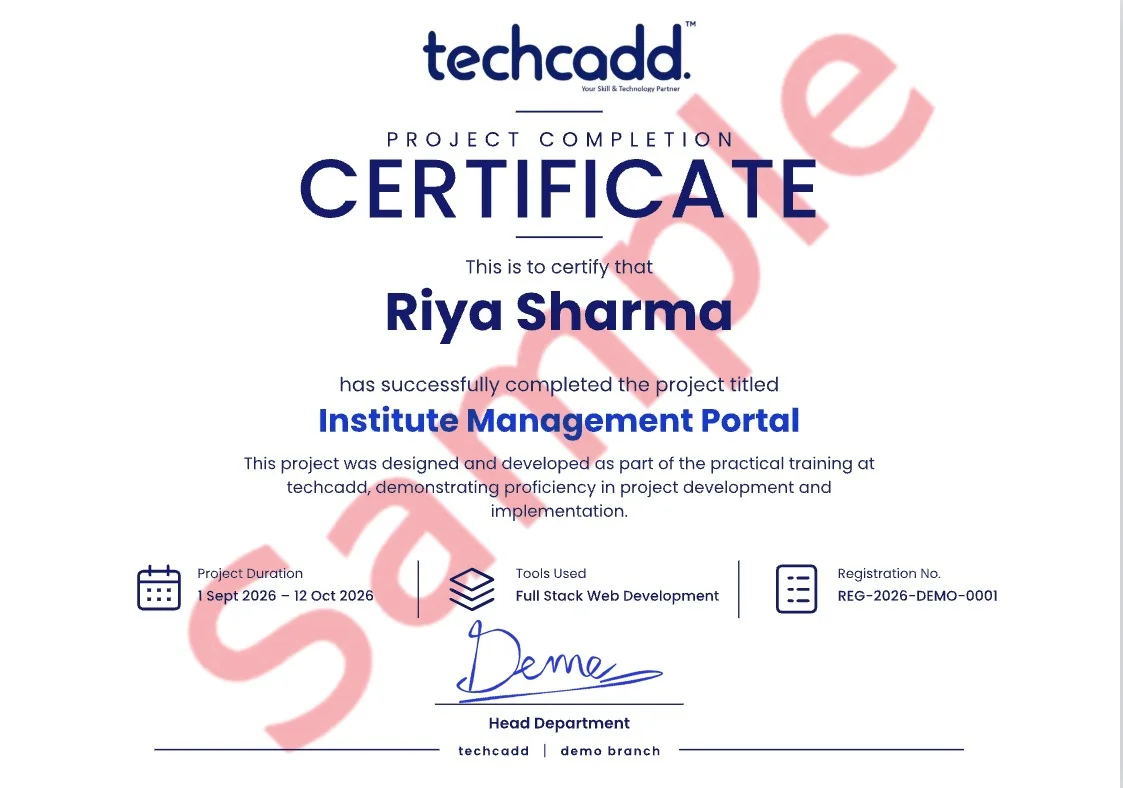
  • Project certificate

    A separate certificate for the capstone you submit, naming the project so the work is attached to the credential.

  • Internship letter

    Students who complete the live-project phase receive an internship letter covering the duration and the work delivered.

  • Portfolio you own

    Every file, repository and deployed link stays yours — the part of the credential a reviewer can actually open.

techcadd has been training in Ludhiana since 2007. The certificate carries that record; the deep learning work you did carries the rest.

Sample techcadd course completion certificate
Course completion
Sample techcadd project completion certificate
Project & internship

Where it takes you

Where this course takes you

The route from your first module to the roles Deep Learning opens — and the work that has to exist at each step.

  1. 01Learning
  2. 02Projects
  3. 03Portfolio
  4. 04Industry readiness
  5. 05Career opportunities
  • Deep Learning Engineer

    Design and train the models behind vision and language products.

  • Computer Vision Engineer

    Ship detection, segmentation and recognition systems.

  • NLP Engineer

    Fine-tune and serve language models for real tasks.

  • AI Research Engineer

    Reproduce papers and turn them into working implementations.

  • ML Platform Engineer

    Build the training and inference infrastructure a team depends on.

  • Applied AI Developer

    Integrate deep models into products that people use.

Salary outlook

What deep learning work pays

The highest-paying and narrowest of the data routes. There are few deep learning titles in Punjab; the roles below are mostly won remotely or in the metros.

Indicative annual packages by role and market
RoleLudhiana & PunjabDelhi NCR & BengaluruRemote & freelance
Deep Learning EngineerEntry₹3.5–6.0 LPA₹6–14 LPA₹50k–1.4L / project
Computer Vision EngineerEntry to mid₹3.6–6.5 LPA₹7–16 LPA₹60k–1.6L / project
NLP EngineerEntry to mid₹3.6–6.5 LPA₹7–16 LPA₹60k–1.6L / project
Senior AI / DL EngineerMid (3–5 yrs)₹7–13 LPA₹14–30 LPA₹1.5L–4L / project

Ranges are indicative, drawn from what our own students report and from openings we see through the placement cell. Actual offers depend on your portfolio, the interview and the company — nobody can promise you a number, and we do not.

  • Deep learning engineer, computer vision engineer, NLP engineer, applied AI developer and ML platform engineer. Research-titled roles usually want a postgraduate degree as well; the applied roles want models you have trained and can explain.

  • Strong, from a high base, for people who specialise. Vision and NLP diverge quickly — picking one and going deep is worth more after two years than staying across both.

  • Yes, and often internationally. Model work is reviewed on repositories, notebooks and metrics, all of which travel; several of our students take remote contracts for vision work in manufacturing quality control.

  • Locally, computer vision has the clearest use: quality inspection and defect detection in Ludhiana's auto-component and textile units. Beyond that, healthcare imaging, agri-tech near PAU, and remote or metro product teams. It is a smaller local market than data analytics and we would rather say so.

  • The most academically transferable course in this column. Trained models with a proper evaluation write-up read directly as research experience for an M.Tech, MS or PhD application.

Why this programme

Why this program

There is no shortage of machine learning courses. What follows is what makes this one worth the time for someone actually based in Ludhiana.

  1. Industry-Relevant Curriculum, Not Just Theory

    A lot of institutes teach machine learning as a set of PowerPoint concepts. This program is structured around what companies are actually hiring for: applied Python, real-world datasets, model deployment, and Generative AI fundamentals alongside classic ML and DL topics. You leave with skills that map to job descriptions, not exam answers.

  2. Hands-On Projects You Can Show Employers

    Throughout the program you build and deploy image classifiers, recommendation systems, sentiment analysis tools, and predictive models using real datasets. By the end you have a GitHub-ready portfolio you can show recruiters in Ludhiana, Chandigarh, or during remote interviews with companies anywhere in India.

  3. Local Access, No Relocation Needed

    Most premium AI and ML training in North India is concentrated in Chandigarh, Delhi-NCR, or Bangalore, forcing Ludhiana students to either relocate or settle for purely online courses with little support. Classroom-based, mentor-led training here means local students save on relocation costs while still getting hands-on instruction.

  4. Bridges the Gap Between College and Industry

    Engineering and computer science syllabi at PTU-affiliated colleges move slowly and rarely cover current AI tools, frameworks, or real deployment practices. This program is designed specifically to close that gap, giving graduates and final-year students the practical skill set campus placements alone don’t provide.

  5. Career-Focused Outcomes, Not Just Certification

    The goal isn’t to hand you a certificate — it’s to make you employable. That means resume-building support, interview preparation, and guidance on positioning your AI and ML skills for roles like Machine Learning Engineer, Data Analyst, AI Developer, and Data Scientist. For Ludhiana students that also includes guidance on remote opportunities, since many of the best-paying AI roles today are remote-first.

  6. Strong Foundation for Future Specializations

    ML and AI are foundational to nearly every emerging tech field — from Generative AI and NLP to computer vision and robotics. Completing this certificate gives you a base to specialize further, pursue higher studies, or move into more advanced AI roles as the field evolves.

  7. Growing Demand Across Punjab’s Industries

    Ludhiana’s economy — hosiery, textiles, auto-parts, and a rising IT and startup sector — is starting to adopt AI-driven tools for demand forecasting, quality control, and automation. Locally trained ML professionals who understand both the technology and Punjab’s business context have a genuine advantage, for local employment and for consulting with regional industries.

  8. The Right Time to Start

    Machine learning and deep learning are consistently ranked among the fastest-growing tech skills globally. Entering the field while local competition for specialized AI talent is still relatively low compared with metro cities offers a real head start.

Skills that map to job descriptions, projects you can show, and no relocation required — that is the whole argument for learning this here rather than somewhere else.

Why techcadd

Why choose techcadd

What separates a local institute from an online platform is whether anyone notices when you fall behind. Here is how this program is set up.

  1. A Training Institute That Understands Ludhiana’s Students

    techcadd isn’t a generic online platform serving every city the same way — it’s built around the needs of students and professionals based in Ludhiana. From batch timings that work around local college schedules and job shifts, to guidance that factors in Punjab’s job market, the approach is shaped by who actually walks through the doors: 12th-pass students, PTU-affiliated graduates, working professionals, and career switchers.

  2. Expert-Led, Mentor-Based Training

    Rather than pushing students through pre-recorded videos with no support, the program is led by trainers with real industry and project experience. You get direct mentorship — the kind where you can ask “why did the model overfit?” and get a real answer, not a canned response. That matters most for students from non-CS backgrounds who need support building confidence in Python, statistics, and neural network concepts.

  3. Balanced Curriculum: ML + Deep Learning + Practical AI Tools

    Many institutes offer either a basic ML course or a basic AI awareness course — rarely both, and rarely in depth. This program covers the full spectrum: core machine learning algorithms, deep learning architectures including CNNs, RNNs and Transformers, and exposure to modern Generative AI tools. That makes for a genuinely well-rounded certificate rather than a narrow skill set.

  4. Project-First Teaching Philosophy

    Learning isn’t confined to slides and theory. Every major concept is reinforced through a hands-on project, so by the time you finish you already have practical experience solving real problems with real data. This is what separates a resume that gets shortlisted from one that gets skipped.

  5. Placement Support Rooted in Local Networks

    techcadd works to connect students with placement opportunities relevant to Ludhiana and the broader Punjab region, as well as remote roles with companies outside the state. That dual approach means students aren’t limited to local openings alone.

  6. Flexible Learning Formats for Every Kind of Student

    Not every learner has the same schedule. Evening and weekend batch options mean upskilling in machine learning and deep learning doesn’t require putting your current job, college, or business on hold.

  7. Affordable, Transparent Fee Structure

    Compared with metro-city institutes and international certification programs, techcadd offers a training investment accessible to Ludhiana’s student and professional community — without cutting curriculum depth or mentor support.

  8. A Name Trusted Locally for IT & Tech Training

    techcadd has built its reputation in Ludhiana around practical, job-focused IT and tech education. Choosing a local institute with an established presence — rather than an anonymous online-only platform — means accountability, in-person support when you need it, and a training partner invested in your outcome.

Mentorship you can interrupt with a question, a curriculum that covers both halves of the field, and a project after every concept.

Enrol now

Start your AI career right here in Ludhiana

Stop searching for AI courses in Chandigarh or Delhi.

  1. What you get

    Expert-led, project-based Machine Learning & Deep Learning training in Ludhiana — Python and statistics through to CNNs, RNNs, Transformers, NLP and Generative AI, with a GitHub-ready portfolio at the end of it.

  2. Before you enrol

    Course duration varies by batch type — regular, weekend or fast-track. Batch sizes are kept small so every student gets personal mentorship, so contact the Ludhiana centre for the current schedule, exact duration, fees and the centre address.

Future scope

The road ahead for deep learning

A course ends; the field does not. Here is the honest version of what the next few years look like for deep learning — where the roles go, and what is shifting underneath them while you learn.

  1. Year 0–1

    Get in on proof of work

    Entry roles such as Deep Learning Engineer open as soon as you have projects that run. At this stage nobody is asking about your marks — they are asking you to walk through something you built.

  2. Year 2–4

    Specialise and get paid for it

    The generalists plateau; the specialists do not. Depth in one part of deep learning — the part your first job leans on hardest — is what moves you towards computer vision engineer work.

  3. Year 5+

    Own the decisions

    Architecture, standards, hiring and mentoring. The technical skill is assumed by now; what you are paid for is judgement, and judgement only comes from having shipped things that mattered.

Sectors hiring for this skill set

  • IT services
  • Product startups
  • Banking & fintech
  • Healthcare
  • E-commerce
  • Manufacturing
  • EdTech
  • Government & PSUs

The comparison

Why students pick techcadd for Deep Learning

Every institute in Ludhiana claims industry training and placement support. These are the differences you can actually check on a demo visit — ask any of them of anyone, including us.

techcadd compared with a typical institute, feature by feature
What to ask abouttechcaddTypical institute
Who teachesTrainers who still do deep learning work outside the classroomFull-time faculty teaching from a fixed deck
1-on-1 classesOne-to-one teaching available on every course — the pace is yours, and your work is looked at by nameOne group class moving at one pace, whoever that pace happens to suit
Project work5 real projects plus a capstone you deploy and defendGuided exercises copied from the board
CurriculumReviewed every batch against what working teams shipUpdated when the printed syllabus is reprinted
How a module endsA lab task that has to run before you move onNotes to revise before an exam
Doubt supportTrainer sits with your code; open lab hours between classesAsk at the end of class if there is time left
What you leave withCompletion certificate, project certificate, internship letter — all verifiableOne printed certificate
After the coursePortfolio review, mock interviews, referrals, continued doubt supportThe course ends and so does the contact

Written about the market, not about any particular institute in it. Visit two or three, sit through a demo class at each, and ask all eight of these questions — that is the only version of this table worth trusting.

Student Voices

What Deep Learning learners say

Feedback from students who completed the Deep Learning programme at techcadd Ludhiana.

Google Reviews4.8from 181 Google reviewsGoogle Verified
SK

Simranjit Kaur

ML & Deep Learning / B.Tech CSE graduate, Ludhiana

I finished my B.Tech from a college near PAU and honestly felt lost about what to do next. Joined techcadd’s ML & Deep Learning course and it completely changed my direction. The trainers actually explain the “why” behind every algorithm, not just the code. Got my first data analyst interview call within a month of finishing the course.

Posted on Google
RM

Rahul Mehta

ML & Deep Learning / BCA graduate, Model Town, Ludhiana

Was confused between doing an MCA or trying something practical. Chose techcadd’s course and it was the right call. The projects section is solid — I built a real image classifier and a recommendation system, both of which I showed in my interviews. Recommend this to anyone from Ludhiana looking to get into AI without moving to Chandigarh.

Posted on Google
HS

Harpreet Singh

ML & Deep Learning / Working professional, Sarabha Nagar

I work in IT support and wanted to upskill into ML without quitting my job. The weekend batch worked perfectly for my schedule. Deep Learning module took effort to grasp but the mentors were patient. Only wish the batch size was slightly smaller, but overall very satisfied.

Posted on Google
IS

Ishita Sharma

ML & Deep Learning / 12th pass student, Ludhiana

I joined right after 12th, still in first year of college now, and it’s honestly given me a huge head start over my classmates. Understanding Python and basic ML before starting my degree made my first-year coursework so much easier. My trainer was really encouraging even though I had zero coding background.

Posted on Google
AB

Arjun Bansal

ML & Deep Learning / B.Tech, GNE Ludhiana

Compared this with a few Chandigarh institutes before deciding. techcadd’s course content is honestly at par, but without the daily travel. The Deep Learning module covering CNNs and RNNs was detailed and the mentor made sure everyone actually understood the math, not just copy-pasted code.

Posted on Google
PC

Priya Chawla

ML & Deep Learning / MCA graduate, Ludhiana

Good structured course. What I liked most was the project-first approach — by week 4 I was already building actual models instead of just watching slides. Placement support helped me get connected with a couple of relevant openings. Would’ve liked a bit more NLP depth, but overall a strong course.

Posted on Google
GS

Gurpreet Singh

ML & Deep Learning / Business owner, Focal Point, Ludhiana

I run a small manufacturing unit and wanted to understand how AI could help with demand forecasting. This course gave me exactly that — practical understanding, not just buzzwords. The trainers were patient with someone from a non-technical background like me.

Posted on Google
NK

Neha Kapoor

ML & Deep Learning / B.Sc IT, Ludhiana

Switched from thinking about a generic IT job to actually pursuing data science because of this course. The hands-on projects gave me real confidence to talk about my skills in interviews. techcadd’s mentors were always available for doubts, even after class hours.

Posted on Google
VS

Vikramjit Singh

ML & Deep Learning / Career restart, Ludhiana

Had a 2-year career gap and was nervous about restarting in a technical field. This course eased me in well — started from Python basics before jumping into heavier ML and DL concepts. Got a junior data analyst role in Mohali after completing it. Grateful for the structured approach.

Posted on Google
RK

Ramanpreet Kaur

ML & Deep Learning / Engineering graduate, Chandigarh

Traveled from Chandigarh a few times for in-person sessions but most of it was manageable remotely too. Compared techcadd to a couple of Chandigarh-based institutes and found the mentorship and project quality genuinely better here. Solid course for anyone serious about ML and DL.

Posted on Google
AV

Aditya Verma

ML & Deep Learning / B.Tech final year, PTU-affiliated college

Did this alongside my final year to strengthen my resume before placements. It worked — recruiters were impressed that I had real project experience beyond my college syllabus. The trainers are approachable and genuinely invested in helping students succeed.

Posted on Google

Real, unedited feedback from techcadd learners on Google.

Frequently asked questions

Questions before you enrol

The 12 things people ask most often about the Deep Learning course at techcadd Ludhiana.

  • It is a career-focused, hands-on training program covering core Machine Learning algorithms, Deep Learning architectures (CNNs, RNNs, Transformers), NLP fundamentals, and practical Generative AI exposure — designed for students and professionals in Ludhiana who want job-ready AI skills.

  • 12th-pass students, graduates (B.Tech, BCA, MCA, B.Sc IT/CS), working professionals looking to upskill, career switchers from non-CS backgrounds, and business owners wanting to understand AI applications can all join.

  • No prior coding experience is required. The course starts with Python fundamentals and statistics before progressing to advanced machine learning and deep learning concepts, making it accessible for complete beginners.

  • Course duration varies based on the batch type — regular, weekend, or fast-track. Contact the Ludhiana centre directly for the current schedule and exact duration for your preferred batch.

  • Yes. techcadd offers flexible batch timings, including weekend and evening options, so working professionals and college students in Ludhiana can attend without disrupting their job or studies.

  • You’ll work with Python, NumPy, Pandas, Scikit-learn, TensorFlow/Keras, PyTorch fundamentals, Jupyter Notebook and Google Colab, SQL, Git and GitHub, and OpenCV — the core stack used by ML and AI professionals today.

  • Yes. The course follows a project-first approach, so you’ll build image classifiers, recommendation systems, sentiment analysis tools, and predictive analytics models — all of which you can showcase in interviews.

  • Yes. techcadd offers placement guidance connecting students to opportunities in Ludhiana, the wider Punjab region, and remote-friendly roles with companies elsewhere in India.

  • Graduates can pursue roles such as Machine Learning Engineer, Data Analyst, AI Developer, Junior Data Scientist, and NLP/AI Associate — both in local IT companies and remote positions across India.

  • Unlike self-paced online platforms, this is in-person, mentor-led training based in Ludhiana — combining a structured curriculum, direct doubt-clearing support, hands-on projects, and local placement guidance that purely online courses typically lack.

  • The certificate reflects practical, project-based skill development aligned with current industry hiring standards, and is designed to strengthen your resume for ML and AI roles alongside your academic degree. In practice employers weigh the portfolio and the interview more heavily than any certificate, which is why the projects matter most.

  • Contact techcadd through the enquiry form or by phone for the exact centre address and directions in Ludhiana.

Request a callback

Ready to start your deep learning career?

Speak with the techcadd team before enrolling — confirm the current course duration, batch schedule, fees, curriculum, tools covered and career-support facilities directly with the centre.

  • CourseDeep Learning Course
  • Duration4–5 months
  • ModeClassroom & online batches
  • Centretechcadd Ludhiana

Would rather talk now? +91 98881 22667

Taken from the page you are on — this enquiry reaches the Deep Learning counsellor directly.

Loading the security check…

We never share your number. Expect a call within working hours.

Ready to get started?

Start building your career today.

Talk to a counsellor today. One call is usually enough to know which track fits your degree, your schedule and the job you want.

Call now+91 98881 22667
  • Free career counselling
  • No registration fee
  • Placement support included
InternshipJoin