Build with large language models

Build with LLMs.Ship real products.

Prompting, embeddings, RAG, fine-tuning and agents — how to turn a language model into an application that behaves predictably enough to charge money for.

 3–4 monthsClassroom & online batchesBeginner to job ready
Explore course
4.8/5
Student rating
500+
Students trained
6+
Industry projects
Yes
Placement support
The generative AI tools the course works in, lit up under a hand reaching for them

Admissions open

Free demo class & counselling

Batch slots

  • Weekday
  • Evening
  • Weekend
Talk to a counsellor

Course overview

The Generative AI course in Ludhiana that ends in shipped applications

The Generative AI course in Ludhiana at techcadd takes you from your first API call to a deployed application — prompting, structured output, embeddings, RAG, agents, evaluation and cost control, taught in the order a working team actually meets them.

Generative AI stopped being a demo skill some time ago. Businesses in and around Ludhiana — export houses, hosiery and auto-parts manufacturers, D2C brands, digital agencies, hospitals and IT services firms — are wiring language models into support desks, catalogue copy, document search and internal tooling. What they cannot find locally is somebody who can build one of those features so it behaves the same way twice.

That is the gap this programme is built against. Every module closes with something that runs: a structured extraction pipeline, a document assistant that cites its sources and refuses to invent an answer, an agent that completes a multi-step task with a human approval step. The Gen AI training in Ludhiana market is full of tool tours; this is not one. You will spend more time on evaluation and cost per request than on prompt tricks, because that is what separates a prototype from a feature somebody pays for.

You need working Python and nothing else. No machine learning background is assumed — this course is about building with models, not training them from scratch — and the first module starts from tokens, context windows and what an API call actually costs.

  • Every module ends in a working application
  • Evaluation and cost control taught as first-class topics
  • Deployed apps, not notebook demos

Why here, why now

Why learn Generative AI in Ludhiana

Ludhiana is an industrial city with a young technical population and, until recently, almost no structured Generative AI training. That combination is exactly why the local opportunity is real.

  1. The demand arrived before the supply did

    Manufacturers, exporters and agencies across Ludhiana are buying AI features — support assistants, document search, catalogue generation — and mostly buying them from outside Punjab. A local engineer who can build and defend that work is scarce enough to be worth hiring on the spot.

  2. You do not have to leave to compete

    Remote hiring made the portfolio the qualification. Students from Model Town, Sarabha Nagar, Dugri, BRS Nagar and further out in Khanna, Jagraon and Moga are shortlisted on what they built, and a deployed RAG application is the same evidence whichever pincode it was written in.

  3. Timing beats credentials in a new field

    There is no ten-year veteran of production LLM work. The field is three years old commercially, which means a serious two-year head start out of Ludhiana is competitive with anyone — and that window is open now rather than permanently.

  4. Batches built around a Punjab timetable

    Weekday, weekend, evening and one-to-one batches run at the techcadd centre, so college students from GNDEC, PAU, PCTE and Khalsa, and professionals already working six days, can both actually finish the course rather than start it twice.

The honest version: Generative AI is not a shortcut to a salary. It is a skill with an unusually short distance between learning it and being paid for it, provided what you finish with runs.

Curriculum

A path from first steps to shipped work

5 modules and 30 topics across 3–4 months, in the order they are taught. Each one closes with something that works before the next one opens.

5 learning modules01 / 05
Module 01 · Weeks 1–2

How Language Models Work

Tokens, context windows, sampling and cost — the mechanics behind the API call.

Topics covered

  • Tokenisation
  • Context windows
  • Temperature & sampling
  • Model selection
  • Cost estimation
  • Limitations

Tools & libraries

  • Python
  • Claude API
  • OpenAI API

You finish with

A comparison of three models on the same task, with cost and quality measured.

Module 02 · Weeks 3–5

Prompt Engineering & Structured Output

Getting reliable, parseable answers instead of impressive one-off demos.

Topics covered

  • System prompts
  • Few-shot examples
  • Chain of thought
  • Structured JSON output
  • Guardrails
  • Prompt testing

Tools & libraries

  • Claude API
  • Pydantic
  • JSON Schema

You finish with

An extraction pipeline that returns valid structured data on every run.

Module 03 · Weeks 6–9

Embeddings & RAG

Grounding a model in your own documents so it stops inventing answers.

Topics covered

  • Embeddings
  • Chunking strategies
  • Vector databases
  • Hybrid search
  • Reranking
  • Citation handling

Tools & libraries

  • LangChain
  • FAISS
  • Pinecone
  • LlamaIndex

You finish with

A document assistant that answers only from your corpus and cites its sources.

Module 04 · Weeks 10–12

Agents & Tool Use

Letting a model call functions, use tools and complete multi-step work safely.

Topics covered

  • Tool definitions
  • Agent loops
  • Memory
  • Error recovery
  • Human approval steps
  • Multi-agent patterns

Tools & libraries

  • Claude API
  • LangGraph
  • MCP

You finish with

An agent that completes a real multi-step task with a human approval checkpoint.

Module 05 · Weeks 13–16

Fine-Tuning, Evaluation & Deployment

Measuring quality, reducing cost and running a generative feature in production.

Topics covered

  • When to fine-tune
  • Dataset preparation
  • LLM-as-judge evaluation
  • Caching & batching
  • Latency budgets
  • Deployment

Tools & libraries

  • Hugging Face
  • LoRA
  • FastAPI
  • Streamlit

You finish with

Your capstone deployed with an evaluation suite and a measured cost per request.

Find your pace

What you can do, phase by phase

The Generative AI syllabus in the order you meet it, and what you are able to do by the end of each stretch of it. Every row is a capability, not a topic you sat through.

Every capability in the Generative AI syllabus, and the phase it is covered in
CapabilityFoundationsAppliedProfessional
TokenisationHow Language Models WorkCovered in FoundationsCovered in AppliedCovered in Professional
Context windowsHow Language Models WorkCovered in FoundationsCovered in AppliedCovered in Professional
Temperature & samplingHow Language Models WorkCovered in FoundationsCovered in AppliedCovered in Professional
Model selectionHow Language Models WorkCovered in FoundationsCovered in AppliedCovered in Professional
Cost estimationHow Language Models WorkCovered in FoundationsCovered in AppliedCovered in Professional
LimitationsHow Language Models WorkCovered in FoundationsCovered in AppliedCovered in Professional
System promptsPrompt Engineering & Structured OutputCovered in FoundationsCovered in AppliedCovered in Professional
Few-shot examplesPrompt Engineering & Structured OutputCovered in FoundationsCovered in AppliedCovered in Professional
Chain of thoughtPrompt Engineering & Structured OutputCovered in FoundationsCovered in AppliedCovered in Professional
Structured JSON outputPrompt Engineering & Structured OutputCovered in FoundationsCovered in AppliedCovered in Professional
GuardrailsPrompt Engineering & Structured OutputCovered in FoundationsCovered in AppliedCovered in Professional
Prompt testingPrompt Engineering & Structured OutputCovered in FoundationsCovered in AppliedCovered in Professional
EmbeddingsEmbeddings & RAGNot yet covered in FoundationsCovered in AppliedCovered in Professional
Chunking strategiesEmbeddings & RAGNot yet covered in FoundationsCovered in AppliedCovered in Professional
Vector databasesEmbeddings & RAGNot yet covered in FoundationsCovered in AppliedCovered in Professional
Hybrid searchEmbeddings & RAGNot yet covered in FoundationsCovered in AppliedCovered in Professional
RerankingEmbeddings & RAGNot yet covered in FoundationsCovered in AppliedCovered in Professional
Citation handlingEmbeddings & RAGNot yet covered in FoundationsCovered in AppliedCovered in Professional
Tool definitionsAgents & Tool UseNot yet covered in FoundationsCovered in AppliedCovered in Professional
Agent loopsAgents & Tool UseNot yet covered in FoundationsCovered in AppliedCovered in Professional
MemoryAgents & Tool UseNot yet covered in FoundationsCovered in AppliedCovered in Professional
Error recoveryAgents & Tool UseNot yet covered in FoundationsCovered in AppliedCovered in Professional
Human approval stepsAgents & Tool UseNot yet covered in FoundationsCovered in AppliedCovered in Professional
Multi-agent patternsAgents & Tool UseNot yet covered in FoundationsCovered in AppliedCovered in Professional
When to fine-tuneFine-Tuning, Evaluation & DeploymentNot yet covered in FoundationsNot yet covered in AppliedCovered in Professional
Dataset preparationFine-Tuning, Evaluation & DeploymentNot yet covered in FoundationsNot yet covered in AppliedCovered in Professional
LLM-as-judge evaluationFine-Tuning, Evaluation & DeploymentNot yet covered in FoundationsNot yet covered in AppliedCovered in Professional
Caching & batchingFine-Tuning, Evaluation & DeploymentNot yet covered in FoundationsNot yet covered in AppliedCovered in Professional
Latency budgetsFine-Tuning, Evaluation & DeploymentNot yet covered in FoundationsNot yet covered in AppliedCovered in Professional
DeploymentFine-Tuning, Evaluation & DeploymentNot yet covered in FoundationsNot yet covered in AppliedCovered in Professional

The full programme runs 3–4 months. Where you finish is a question of pace rather than of syllabus — everyone covers all of it.

The case for it

Anyone can call an API. Very few can make it behave.

The distance between a Generative AI demo and a Generative AI feature is measured in evaluation, guardrails and cost. That distance is the entire point of this programme, and it is where the roles are.

5Applications you deploynot notebooks — running, reviewable links
  • You learn generative AI the way it is used in production, with the workflow, tooling and standards a working team expects. Nothing in the syllabus exists only to fill hours.

  • Sessions are hands-on. You do every example, break it, and fix it. Each module closes with a lab task that has to work before you move on.

  • Five shipped finished projects — the kind of work an interviewer can open, click through and question you on.

  • A structured final phase: portfolio review, profile cleanup, aptitude and role-specific practice, mock interviews and placement support.

Why this course

Why should you choose this course?

Six things we hold ourselves to for every Generative AI batch that starts in Ludhiana.

  • 01

    Industry-focused curriculum

    Syllabus built around what generative AI teams actually ship — no filler modules, no theory that never reaches your hands.

  • 02

    Practical learning

    Every concept lands in the tool the same day. You work in generative AI during each class, not just in your notes.

  • 03

    Real-world projects

    Build with real requirements, real data and real problems — from the first task to a finished, reviewable deliverable.

  • 04

    Mentor guidance

    Trainers who work with generative AI daily review your work, your logic and your approach line by line.

  • 05

    Career preparation

    Resume, portfolio, aptitude rounds and interview practice built into the last phase of the course.

  • 06

    Placement support

    Interview referrals, mock rounds and continued doubt support after the course ends.

Who can join

Who this Generative AI course is for

Six kinds of people sit in a typical batch, and none of them arrive knowing generative AI. Find the one that sounds like you.

  • Students after 12th

    You have finished school and want a skill that pays before a degree does. The first module assumes you have never opened generative AI in your life.

    No background needed
  • College students

    BCA, B.Tech, B.Sc, BBA, B.Com — any stream. You learn generative AI alongside your degree and finish with projects your syllabus was never going to give you.

    Weekend batches
  • Final year and fresh graduates

    You are months away from interviews and need work to show, not marks to quote. The final phase is portfolio, mock rounds and referrals.

    Placement support
  • Working professionals

    You already have a job and want generative AI on top of it. Evening and weekend batches exist for exactly this, and the project work is yours to schedule.

    Evening batches
  • Career switchers

    You are coming from a different field entirely — operations, teaching, accounts, sales. Every module starts from why, not from jargon.

    Start from zero
  • Freelancers and business owners

    You want to do this work yourself instead of paying for it. You leave able to build, run and judge generative AI work on your own terms.

    Practical only

What you actually need before day one

3–4 months · Classroom & online batches

  • A laptop or desktop — we help you set it up in the first session
  • A stable internet connection for the online batches
  • Basic Python. You do not need machine learning background — this course is about building with models, not training them from scratch.
  • Basic English reading — the tools and their documentation are in English
  • About 6-8 hours a week outside class for practice
  • Willingness to finish the lab task before the next class

Not sure which of these you are, or whether the timing works around what you already do? That is exactly what the call is for. Ask about Generative AI

Technology ecosystem

One discipline.
A mesh of real tools.

Generative AI is the centre. These are the tools you use around it in a working team.

  • Frontier language models
  • Application framework
  • Open models & tuning
  • Vector search
  • Managed vector database
  • Data framework for LLMs
  • Serving applications
  • Rapid interfaces
  • Claude APIFrontier language models
  • LangChainApplication framework
  • Hugging FaceOpen models & tuning
  • FAISSVector search
  • PineconeManaged vector database
  • LlamaIndexData framework for LLMs
  • FastAPIServing applications
  • StreamlitRapid interfaces

Hands-on projects

Projects you actually ship,
not just follow along with.

Each one lands in your portfolio with the working files, the process and something a reviewer can open.

Capstone project

Grounded Knowledge Assistant

A production-shaped RAG application over a real document set: hybrid retrieval with reranking, cited answers, conversation memory, a refusal path when the corpus has no answer, an automated evaluation suite and a measured cost-per-query budget.

  • RAG
  • Claude API
  • FAISS
  • FastAPI
Difficulty
Advanced
Status
Deployed
View project brief

Certification

Get certified in Generative AI

You finish with a verifiable techcadd Generative AI certificate, an internship letter for the live-project phase, and — the part that actually gets read — deployed applications with the evaluation numbers beside them.

  • Course completion certificate

    Issued in your name on completion of the Generative AI syllabus, with a reference number an employer can verify with us.

  • Project certificate

    A separate certificate for the capstone you submit, naming the project so the work is attached to the credential.

  • Internship letter

    Students who complete the live-project phase receive an internship letter covering the duration and the work delivered.

  • Portfolio you own

    Every file, repository and deployed link stays yours — the part of the credential a reviewer can actually open.

techcadd has been training in Ludhiana since 2007. The certificate carries that record; the generative AI work you did carries the rest.

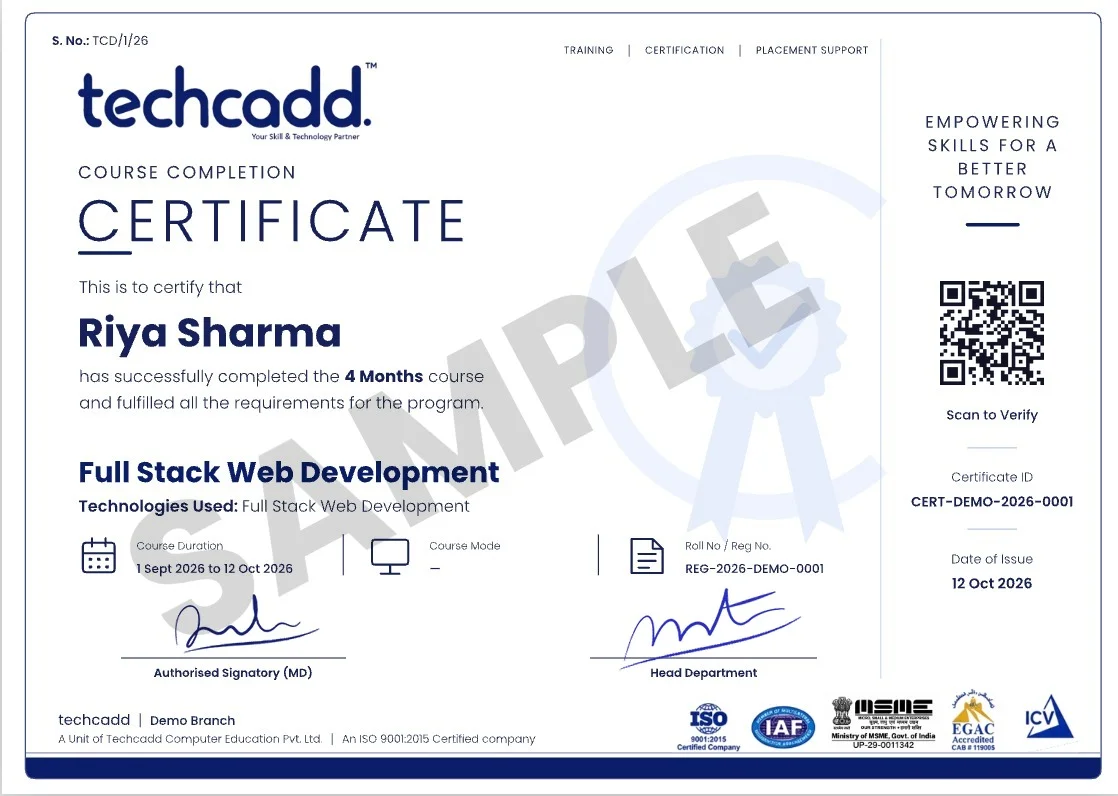
Sample techcadd course completion certificate
Course completion
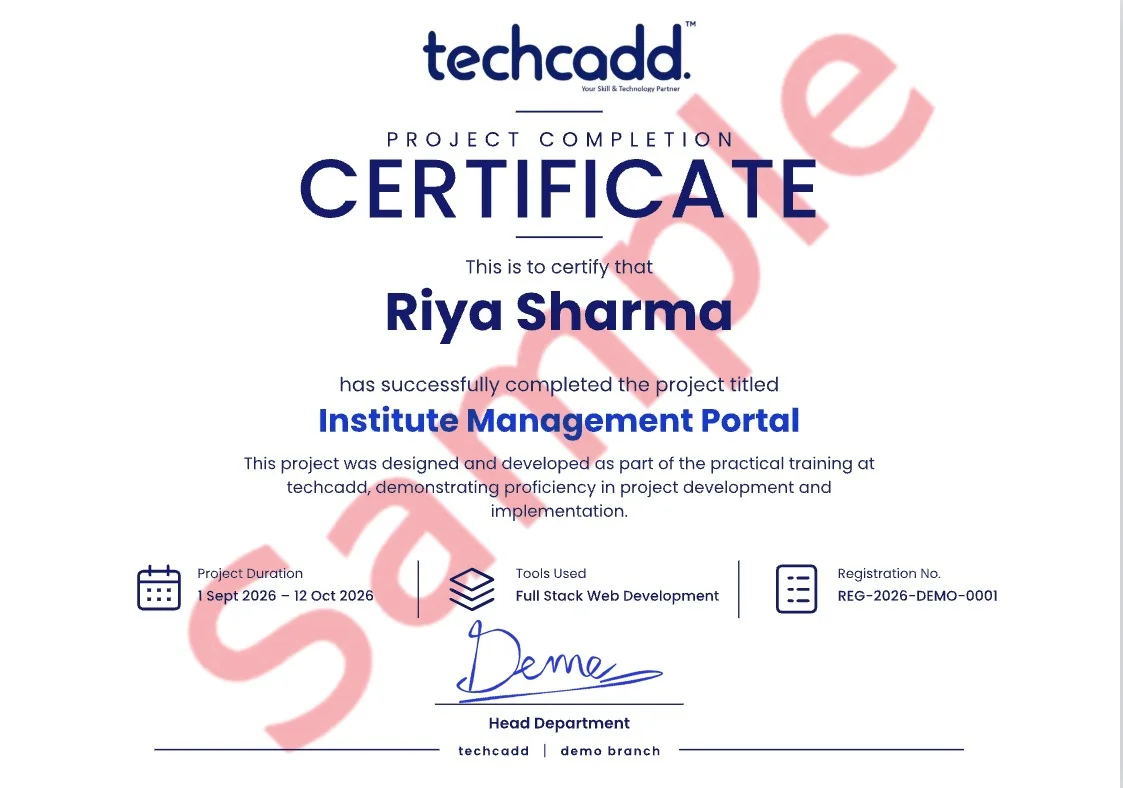
Sample techcadd project completion certificate
Project & internship

Where it takes you

Where this course takes you

The route from your first module to the roles Generative AI opens — and the work that has to exist at each step.

  1. 01Learning
  2. 02Projects
  3. 03Portfolio
  4. 04Industry readiness
  5. 05Career opportunities
  • AI Application Developer

    Build products with language models at their core.

  • Generative AI Engineer

    Own prompting, retrieval and evaluation for a product team.

  • LLM Engineer

    Fine-tune, serve and optimise models in production.

  • AI Product Specialist

    Decide where generative features genuinely help a business.

  • Prompt Engineer

    Design and test the instruction layer behind AI features.

  • AI Consultant

    Advise businesses on realistic, costed AI adoption.

Salary outlook

What Generative AI work pays, and where

Indicative ranges for the roles this course opens. Punjab pays less than the metros for the same skills and always has; the third column is why that matters less every year.

Indicative annual packages by role and market
RoleLudhiana & PunjabDelhi NCR & BengaluruRemote & freelance
AI Application DeveloperEntry₹3.0–5.4 LPA₹5.5–11 LPA₹35k–90k / project
Generative AI EngineerEntry to mid₹3.6–6.5 LPA₹7–16 LPA₹50k–1.4L / project
Prompt EngineerEntry₹2.6–4.8 LPA₹4.5–10 LPA₹20k–60k / project
LLM EngineerMid (2–4 yrs)₹6–11 LPA₹12–26 LPA₹1L–3L / project

Ranges are indicative, drawn from what our own students report and from openings we see through the placement cell. Actual offers depend on your portfolio, the interview and the company — nobody can promise you a number, and we do not.

  • AI application developer, generative AI engineer, prompt engineer, LLM engineer, AI product specialist and AI consultant. In smaller Ludhiana firms these collapse into one job with all of those in it, which is a fast way to learn and a good first year.

  • The first serious jump usually lands at 18–24 months, and it follows depth rather than time. Students who go deep on retrieval quality and evaluation move faster than those who stay broad, because those are the two things a team cannot verify from a CV and always has to hire for.

  • Yes, and this is the most remote-friendly skill techcadd teaches. A deployed RAG assistant with an evaluation report reads the same from Ludhiana as from Bengaluru, and contract work on AI features is routinely awarded off a portfolio link and a call.

  • Locally: IT services firms on Ferozepur Road and Pakhowal Road, D2C and e-commerce brands, digital agencies, export and hosiery houses automating catalogue and correspondence work, hospitals and diagnostic chains digitising records, and education groups. Beyond that, most of our Generative AI students take remote or Mohali/Chandigarh roles.

  • It helps with the applied half of an M.Tech, MCA or an overseas AI specialisation. Admissions panels and scholarship committees increasingly ask what you have built; deployed applications with measured evaluation answer that better than marks.

The local market

Generative AI jobs in Ludhiana and Punjab

What the Generative AI jobs in Ludhiana market actually looks like, rather than what a national salary survey says about it.

  1. The first job is usually broader than the title

    A Punjab-based first role in AI tends to be one person owning prompting, retrieval, the small backend around it and the conversation with the business. That is more responsibility than a metro equivalent and considerably more learning per month.

  2. Agencies hire fastest, product teams pay more

    Digital agencies serving Ludhiana and Chandigarh clients hire generative AI skills quickest, because every client is now asking for it. Product companies in Mohali and NCR pay more and interview harder — the evaluation and cost work in this course is aimed squarely at that second interview.

  3. Freelance is a real first income here

    Document assistants, support copilots and content pipelines are commonly awarded as fixed-scope projects in the ₹35,000 to ₹1.4 lakh range. Several students bill their first project before finishing the course, which is also the fastest way to learn what a client actually checks.

  4. What the interview is actually about

    Nobody will ask you to define a transformer. You will be asked why your retrieval returns what it returns, how you know the answer is grounded, and what the thing costs per query. Those three questions are why the syllabus is shaped the way it is.

Future scope

The road ahead for generative AI

A course ends; the field does not. Here is the honest version of what the next few years look like for generative AI — where the roles go, and what is shifting underneath them while you learn.

  1. Year 0–1

    Get in on proof of work

    Entry roles such as AI Application Developer open as soon as you have projects that run. At this stage nobody is asking about your marks — they are asking you to walk through something you built.

  2. Year 2–4

    Specialise and get paid for it

    The generalists plateau; the specialists do not. Depth in one part of generative AI — the part your first job leans on hardest — is what moves you towards generative ai engineer work.

  3. Year 5+

    Own the decisions

    Architecture, standards, hiring and mentoring. The technical skill is assumed by now; what you are paid for is judgement, and judgement only comes from having shipped things that mattered.

Sectors hiring for this skill set

  • IT services
  • Product startups
  • Banking & fintech
  • Healthcare
  • E-commerce
  • Manufacturing
  • EdTech
  • Government & PSUs

The comparison

Why students pick techcadd for Generative AI

Every institute in Ludhiana claims industry training and placement support. These are the differences you can actually check on a demo visit — ask any of them of anyone, including us.

techcadd compared with a typical institute, feature by feature
What to ask abouttechcaddTypical institute
Who teachesTrainers who still do generative AI work outside the classroomFull-time faculty teaching from a fixed deck
1-on-1 classesOne-to-one teaching available on every course — the pace is yours, and your work is looked at by nameOne group class moving at one pace, whoever that pace happens to suit
Project work5 real projects plus a capstone you deploy and defendGuided exercises copied from the board
CurriculumReviewed every batch against what working teams shipUpdated when the printed syllabus is reprinted
How a module endsA lab task that has to run before you move onNotes to revise before an exam
Doubt supportTrainer sits with your code; open lab hours between classesAsk at the end of class if there is time left
What you leave withCompletion certificate, project certificate, internship letter — all verifiableOne printed certificate
After the coursePortfolio review, mock interviews, referrals, continued doubt supportThe course ends and so does the contact

Written about the market, not about any particular institute in it. Visit two or three, sit through a demo class at each, and ask all eight of these questions — that is the only version of this table worth trusting.

Student Voices

What Generative AI learners say

Feedback from students who completed the Generative AI programme at techcadd Ludhiana.

Google Reviews4.8from 181 Google reviewsGoogle Verified
SK

Simranjeet Kaur

Generative AI / B.Sc. IT graduate

I joined with no background in this. By the third month I was building generative AI work on my own, and the project reviews are where I actually learnt to do it properly.

Posted on Google
HS

Harman Sethi

Generative AI / Now working as an intern in the field

The classes are practical. Every session ends with a task that has to work, so you cannot fake understanding. That habit helped me most in interviews.

Posted on Google
AV

Ankit Verma

Generative AI / BCA final year

Doubt support was the difference for me. My trainer sat with my work, found the mistake and made me fix it myself instead of handing over the answer.

Posted on Google
NS

Navjot Singh

Generative AI / Career switch from operations

I came for the skill and left with a portfolio — projects I could actually demo on a call, not a certificate I had to explain.

Posted on Google

Real, unedited feedback from techcadd learners on Google.

Frequently asked questions

Questions before you enrol

The 13 things people ask most often about the Generative AI course at techcadd Ludhiana.

  • The full programme runs 3–4 months across weekday, weekend and fast-track batches. Fees depend on the batch format and any combination with our Python or AI courses — the counsellor gives you the current figure on the call or at the centre, and there is a demo class before you commit to anything.

  • You need to be comfortable writing basic Python — functions, loops, dictionaries, reading a file. You do not need machine learning, mathematics or a computer science degree. If Python itself is new, students commonly take our Python course first or run the two together.

  • Five applications, all deployed. A content assistant, a PDF question-answering bot with citations, a structured data extractor, a research agent and a support copilot, plus the capstone — a grounded knowledge assistant with an evaluation suite and a measured cost per query.

  • Claude and OpenAI APIs, LangChain and LangGraph, Hugging Face for open models and LoRA fine-tuning, FAISS and Pinecone for vector search, LlamaIndex, FastAPI for serving and Streamlit for interfaces. Model providers change; the course teaches the pattern so switching is a config change, not a relearn.

  • Yes. Evening and Sunday batches exist for exactly this, and the project work is yours to schedule. Roughly a third of every Generative AI batch is already working — mostly developers, marketers and analysts adding this to what they do.

  • Placement support covers portfolio and resume review, mock technical rounds, aptitude practice and referrals through our hiring network in Ludhiana, Mohali, Chandigarh and remote roles. We do not guarantee employment and will not pretend to — what we can commit to is that your work is interview-ready and that support does not stop the day the batch ends.

  • The complete Generative AI programme runs for 3–4 months depending on the batch you choose. Weekday, weekend and fast-track options are available, along with shorter modules for students who only need the fundamentals.

  • School students after 12th, college students from any stream, graduates and working professionals changing track. The first module assumes no prior experience.

  • Basic Python. You do not need machine learning background — this course is about building with models, not training them from scratch.

  • Claude API, LangChain, Hugging Face, FAISS, Pinecone, LlamaIndex, FastAPI and Streamlit — plus the day-to-day tooling and workflow that surrounds them in a real team.

  • Yes. Each module closes with a lab project, and the course ends with a capstone you can put on your portfolio and defend in an interview.

  • Placement support includes resume and portfolio review, aptitude and role-specific practice, mock interviews and interview referrals through our hiring network.

  • Yes. You receive a techcadd Generative AI completion certificate, and a separate project certificate for the capstone you submit.

Next batch

Ask about the Generative AI course in Ludhiana

Batch timings, fees, whether your Python is enough to start, or what the projects actually involve — ask, and you get a straight answer. A free demo class is available before you enrol.

  • CourseGenerative AI Course
  • Duration3–4 months
  • ModeClassroom & online batches
  • Centretechcadd Ludhiana

Would rather talk now? +91 98881 22667

Taken from the page you are on — this enquiry reaches the Generative AI counsellor directly.

Loading the security check…

We never share your number. Expect a call within working hours.

Ready to get started?

Start building your career today.

Talk to a counsellor today. One call is usually enough to know which track fits your degree, your schedule and the job you want.

Call now+91 98881 22667
  • Free career counselling
  • No registration fee
  • Placement support included
InternshipJoin