Cybersecurity Fundamentals
The core principles of cybersecurity and the legal framework.
You finish with
A security fundamentals report.
Cyber SecurityMost In-Demand
The investigation skillset Punjab's growing IT and financial sector is hiring for right now.
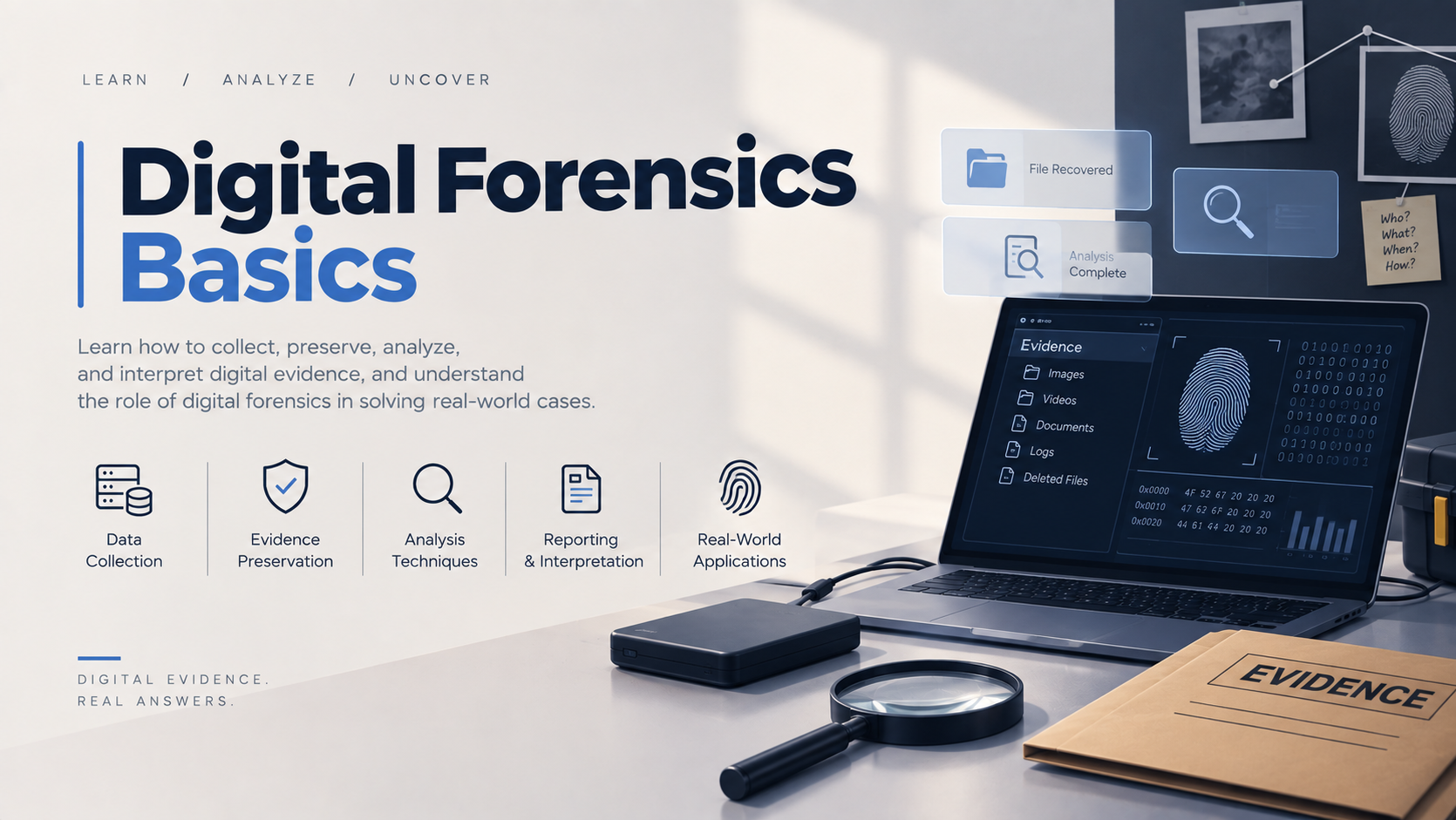
This programme covers digital forensics fundamentals through hands-on labs, live projects, and mentor-reviewed deliverables. You will build practical skills in evidence handling, disk analysis, memory forensics, and incident response, with dedicated placement support at the end.
Admissions open
Free demo class & counselling
Batch slots
Course overview
This Digital Forensics Basics Course in Ludhiana is a structured programme covering forensic investigation, from fundamental concepts through to evidence handling, disk analysis, memory forensics, and reporting. The learning arc moves from foundations (cybersecurity, operating systems, networking) to applied work (evidence handling, disk imaging, memory analysis, incident response) to a capstone project where you investigate a real incident and produce a full forensic report. Students finish with a portfolio of module deliverables, a documented internship certificate, and interview readiness for junior forensic analyst and incident response roles in the local market. The 9-month Expert plan adds a final stage focused on network architecture, advanced SOC and DFIR skills, and career readiness for those targeting senior or specialised roles.
Curriculum
The syllabus is structured as a ladder, not a set of parallel tracks. Each plan builds on the previous one, and longer plans repeat the full module list of shorter plans before adding their own advanced modules. This means you can start at the level that matches your experience and progress upward without gaps.
The core principles of cybersecurity and the legal framework.
You finish with
A security fundamentals report.
Operating system security and user management.
You finish with
A hardened OS configuration.
How networks work and how to secure them.
You finish with
A network diagram and configuration.
Setting up a virtual lab for security testing.
You finish with
A working virtual security lab.
Version control for security scripts and documentation.
You finish with
A version-controlled repository.
Using AI tools for security research and automation.
You finish with
An AI-assisted security task.
Reconnaissance techniques for security assessments.
You finish with
A reconnaissance report.
Scanning and assessing network vulnerabilities.
You finish with
A vulnerability assessment report.
Web application security testing.
You finish with
A web security assessment.
Security operations centre fundamentals.
You finish with
A SOC monitoring setup.
Offensive security techniques and tools.
You finish with
A penetration testing report.
Automating security tasks with Python.
You finish with
A security automation script.
Building AI-powered security tools.
You finish with
An AI security assistant.
A complete industry-level security project.
You finish with
A full security project deliverable.
Advanced threat detection and response.
You finish with
A threat detection use case.
Integrating security into DevOps pipelines.
You finish with
A DevSecOps pipeline
Forensic investigation techniques.
You finish with
A forensic analysis report.
Analysing malware and using threat intelligence.
You finish with
A malware analysis report.
Responding to and recovering from security incidents.
You finish with
What they build in it: An
Building and deploying an AI-integrated security solution.
You finish with
A deployed AI security capstone.
Planning a full-scale security project.
You finish with
A project plan and architecture document.
Building and hardening the capstone project
You finish with
A working security implementation.
Adding advanced AI and automation features.
You finish with
An advanced feature set.
Career preparation for senior security roles.
You finish with
Certification readiness and interview skills.
Every module includes hands-on practice on a real lab environment or a real deliverable, not a slide demonstration.
What you learn
The Digital Forensics Basics Course in Ludhiana at techcadd is designed to help students move from basic cybersecurity concepts to practical, investigation-ready skills.
Understand the CIA triad, cyber laws, Windows and Linux user permissions, and build a hardened operating system configuration.
Work with OSI/TCP-IP, IP addressing, routing, DNS, and VPNs, and set up a virtual security lab using VMware, VirtualBox, and Kali Linux.
Use OSINT, Google Dorking, WHOIS, and DNS enumeration to map an attack surface and produce a reconnaissance report.
Learn the correct procedures for collecting, preserving, and documenting digital evidence so it stands up to scrutiny.
Acquire and analyse disk images using forensic tools, recover deleted data, and produce a full forensic analysis report.
Analyse memory dumps to identify malicious processes and artefacts, and document findings in a memory forensics report.
Investigate security incidents from detection to containment, eradication, and recovery, with AI-assisted DFIR workflows.
Complete a full forensic investigation of a simulated breach, from evidence collection to a final court-ready report.
Tools you’ll work with
The objective is practical knowledge rather than memorised concepts — every module produces a portfolio-ready deliverable you can show to employers.
The case for it
A course is worth the time you give it only if you finish with work you can show and skills you can defend.
Understand the CIA triad, cyber laws, Windows and Linux permissions, and build a hardened operating system configuration.
Work with OSI/TCP-IP, IP addressing, routing, DNS, and VPNs, and set up a working virtual security lab using VMware, VirtualBox, Kali Linux, and Windows Server.
Apply ChatGPT, Gemini, and Copilot for security research, and gather intelligence using OSINT, Google Dorking, WHOIS, and DNS enumeration.
Scan networks with Nmap, OpenVAS, Nessus, and Qualys, and test web applications for OWASP Top 10 flaws using Burp Suite.
Monitor logs and detect threats using SIEM tools like Wazuh and Splunk, applying MITRE ATT&CK and incident response workflows.
Collect and preserve digital evidence with a proper chain of custody, then acquire and analyse disk images to recover deleted data.
Examine memory dumps to identify malicious processes, and run full incident response workflows from detection through containment, eradication, and recovery.
Perform static and dynamic malware analysis with sandboxing, and apply IOC, TTP, STIX, and TAXII frameworks.
Build and deploy a full forensic investigation of a simulated breach, from evidence collection to a final court-ready report.
Why this course
Six things we hold ourselves to for every Digital Forensics Basics batch that starts in Ludhiana.
Every module includes practical exercises on real forensic tools and environments, not simulations.
You work on live projects that mirror what forensic teams actually do, from evidence collection to incident reporting.
Every project is reviewed by mentors who still work on client investigations, not just teach.
Limited seats per batch ensure you get individual attention and feedback on your work.
Why TechCadd
What genuinely differs about this course at techcadd is that every module ends with a deliverable that goes into your portfolio, not a test score.
Your instructors are active security professionals, not full-time trainers, so you learn what the industry actually uses.
You work on real lab environments with real constraints, not simulations or case studies.
Limited seats mean you get individual feedback on every deliverable.
With campuses in Ludhiana, Mohali, Chandigarh, Phagwara, Hoshiarpur, Amritsar, and Jalandhar, techcadd has a local presence and a track record of over 10,000 students trained.
Who can join
This course fits anyone who wants to build a career in digital forensics but needs a structured path from fundamentals to job-ready skills.
You get a complete foundation in cybersecurity and forensics, starting with operating systems and networking and progressing to forensic investigation, with a portfolio you can show employers.
You can upskill in evidence handling, disk analysis, and memory forensics through weekend batches, with deliverables that apply directly to your current work.
You start from the basics and build up to a capstone project, giving you a demonstrable skill set even if your background isn't in IT.
You learn to investigate cyber incidents properly, from evidence collection to reporting, without depending on external consultants.
Not sure which of these you are, or whether the timing works around what you already do? That is exactly what the call is for. Ask about Digital Forensics Basics
Technology ecosystem
Digital Forensics Basics is the centre. These are the tools you use around it in a working team.
Hands-on projects
Each one lands in your portfolio with the working files, the process and something a reviewer can open.
Certification
Finish the Digital Forensics Basics programme at techcadd Ludhiana and you leave with more than a line on a CV — a verifiable certificate, and the project work that makes it mean something in an interview.
Issued in your name on completion of the Digital Forensics Basics syllabus, with a reference number an employer can verify with us.
A separate certificate for the capstone you submit, naming the project so the work is attached to the credential.
Students who complete the live-project phase receive an internship letter covering the duration and the work delivered.
Every file, repository and deployed link stays yours — the part of the credential a reviewer can actually open.
techcadd has been training in Ludhiana since 2007. The certificate carries that record; the Digital Forensics Basics work you did carries the rest.
This is to certify that
has successfully completed the Digital Forensics Basics programme
Digital Forensics Basics Course
This is to certify that
for project work delivered under supervision in Ludhiana
Digital Forensics Basics capstone
Where it takes you
The route from your first module to the roles Digital Forensics Basics opens — and the work that has to exist at each step.
Employers check your ability to acquire and analyse disk images and produce a clean forensic report.
Employers check your ability to investigate security incidents and document findings.
Employers check your ability to monitor alerts, triage incidents, and use SIEM tools like Splunk and Wazuh.
Employers check your ability to perform static and dynamic analysis of suspicious files.
Employers check your ability to perform vulnerability assessments and interpret scan results.
Salary outlook
Indicative ranges for the roles this course opens — what a fresher out of Ludhiana is offered, what the metro and remote markets pay for the same skills, and how that moves with two or three years of work behind you.
| Role | Ludhiana & Punjab | Delhi NCR & Bengaluru | Remote & freelance |
|---|---|---|---|
| Digital Forensics AnalystEntry | ₹2.4–4.2 LPA | ₹4–8 LPA | ₹20k–45k / project |
| Incident Response AnalystEntry to mid | ₹3.6–6.5 LPA | ₹6.5–14 LPA | ₹35k–90k / project |
| SOC AnalystEntry to mid | ₹3.6–6.5 LPA | ₹6.5–14 LPA | ₹35k–90k / project |
| Malware AnalystMid | ₹3.6–6.5 LPA | ₹6.5–14 LPA | ₹35k–90k / project |
Ranges are indicative, drawn from what our own students report and from openings we see through the placement cell. Actual offers depend on your portfolio, the interview and the company — nobody can promise you a number, and we do not.
Digital Forensics Analyst, Incident Response Analyst, SOC Analyst, Malware Analyst and related positions, depending on which part of the syllabus you go deepest on.
The first jump usually comes at 18–24 months, once you have shipped work you can point to. Depth in one area moves it faster than breadth across many.
Yes, and a good number of our students do. Remote and contract work is the reason Ludhiana candidates now compete for the same briefs as metro ones — the portfolio travels, the address does not matter.
IT services, manufacturing and export units running automation, e-commerce and D2C brands, healthcare, education, and the agencies serving all of them. Punjab hiring is broader than it looks from a job board.
It helps with the practical half. The projects and tooling carry into an M.Tech, MCA or a specialisation abroad, and the portfolio is often what separates two applicants with the same marks.
Future scope
A course ends; the field does not. Here is the honest version of what the next few years look like for Digital Forensics Basics — where the roles go, and what is shifting underneath them while you learn.
Entry roles such as Digital Forensics Analyst open as soon as you have projects that run. At this stage nobody is asking about your marks — they are asking you to walk through something you built.
The generalists plateau; the specialists do not. Depth in one part of Digital Forensics Basics — the part your first job leans on hardest — is what moves you towards incident response analyst work.
Architecture, standards, hiring and mentoring. The technical skill is assumed by now; what you are paid for is judgement, and judgement only comes from having shipped things that mattered.
Teams expect Digital Forensics Basics work to be done alongside AI tooling. It raises the floor on output and raises the bar on what counts as a junior — which is exactly why the fundamentals in this course are taught the hard way.
What used to be one narrow role now touches data, deployment and the product decision behind it. Every extra layer of Digital Forensics Basics you understand is another kind of room you get invited into.
Remote and hybrid hiring means Ludhiana, Jalandhar and Chandigarh candidates now compete for the same roles as Bengaluru ones. Location has stopped being the ceiling it used to be.
Hiring has moved to portfolios, take-home tasks and live problem solving. A certificate opens a shortlist; work that runs is what gets you through the round after it.
Sectors hiring for this skill set
The comparison
This comparison covers the key differences between techcadd's Digital Forensics Basics Course and typical alternatives.
| What to ask about | techcadd | Typical institute |
|---|---|---|
| Hands-on labs | Every module, from week one | Often only theory or limited labs |
| Batch size | Small, limited seats | Large, lecture-style batches |
| Mentor background | Active security professionals who do client work | Full-time trainers, often not current practitioners |
| Deliverables | Portfolio-ready projects every module | Tests and certificates |
| AI integration | Built into the syllabus from month 6 | Rarely covered, or optional add-on |
Every comparison here is about substance, not marketing language.
Student Voices
Feedback from students who completed the Digital Forensics Basics programme at techcadd Ludhiana.
Simranjeet Kaur
Digital Forensics Basics / B.Sc. IT graduate
I joined with no background in this. By the third month I was building Digital Forensics Basics work on my own, and the project reviews are where I actually learnt to do it properly.
Harman Sethi
Digital Forensics Basics / Now working as an intern in the field
The classes are practical. Every session ends with a task that has to work, so you cannot fake understanding. That habit helped me most in interviews.
Ankit Verma
Digital Forensics Basics / BCA final year
Doubt support was the difference for me. My trainer sat with my work, found the mistake and made me fix it myself instead of handing over the answer.
Navjot Singh
Digital Forensics Basics / Career switch from operations
I came for the skill and left with a portfolio — projects I could actually demo on a call, not a certificate I had to explain.
Simranjeet Kaur
Digital Forensics Basics / B.Sc. IT graduate
I joined with no background in this. By the third month I was building Digital Forensics Basics work on my own, and the project reviews are where I actually learnt to do it properly.
Harman Sethi
Digital Forensics Basics / Now working as an intern in the field
The classes are practical. Every session ends with a task that has to work, so you cannot fake understanding. That habit helped me most in interviews.
Ankit Verma
Digital Forensics Basics / BCA final year
Doubt support was the difference for me. My trainer sat with my work, found the mistake and made me fix it myself instead of handing over the answer.
Navjot Singh
Digital Forensics Basics / Career switch from operations
I came for the skill and left with a portfolio — projects I could actually demo on a call, not a certificate I had to explain.
Simranjeet Kaur
Digital Forensics Basics / B.Sc. IT graduate
I joined with no background in this. By the third month I was building Digital Forensics Basics work on my own, and the project reviews are where I actually learnt to do it properly.
Harman Sethi
Digital Forensics Basics / Now working as an intern in the field
The classes are practical. Every session ends with a task that has to work, so you cannot fake understanding. That habit helped me most in interviews.
Ankit Verma
Digital Forensics Basics / BCA final year
Doubt support was the difference for me. My trainer sat with my work, found the mistake and made me fix it myself instead of handing over the answer.
Navjot Singh
Digital Forensics Basics / Career switch from operations
I came for the skill and left with a portfolio — projects I could actually demo on a call, not a certificate I had to explain.
Real, unedited feedback from techcadd learners on Google.
Frequently asked questions
The 7 things people ask most often about the Digital Forensics Basics course at techcadd Ludhiana.
The complete Digital Forensics Basics programme runs for 3,6 or 9 months depending on the batch you choose. Weekday, weekend and fast-track options are available, along with shorter modules for students who only need the fundamentals.
School students after 12th, college students from any stream, graduates and working professionals changing track. The first module assumes no prior experience.
No. The course starts from the basics. If you already have some background, your trainer will move you faster through the first module so you reach the project work sooner.
Kali Linux, Ubuntu, Windows 10/11, VMare, Autopsy, Volatility, wireshark, Nmap, Burp Suite, Metasploit, Splunk, Wazuh, Python, Bash and Power Shell — plus the day-to-day tooling and workflow that surrounds them in a real team.
Yes. Each module closes with a lab project, and the course ends with a capstone you can put on your portfolio and defend in an interview.
Placement support includes resume and portfolio review, aptitude and role-specific practice, mock interviews and interview referrals through our hiring network.
Yes. You receive a techcadd Digital Forensics Basics completion certificate, and a separate project certificate for the capstone you submit.
Next batch
Send this form and a counsellor calls you back about this course specifically — batch dates, fees and whether it fits what you already know.
Would rather talk now? +91 98881 22667
Ready to get started?
Talk to a counsellor today. One call is usually enough to know which track fits your degree, your schedule and the job you want.
Call now+91 98881 22667