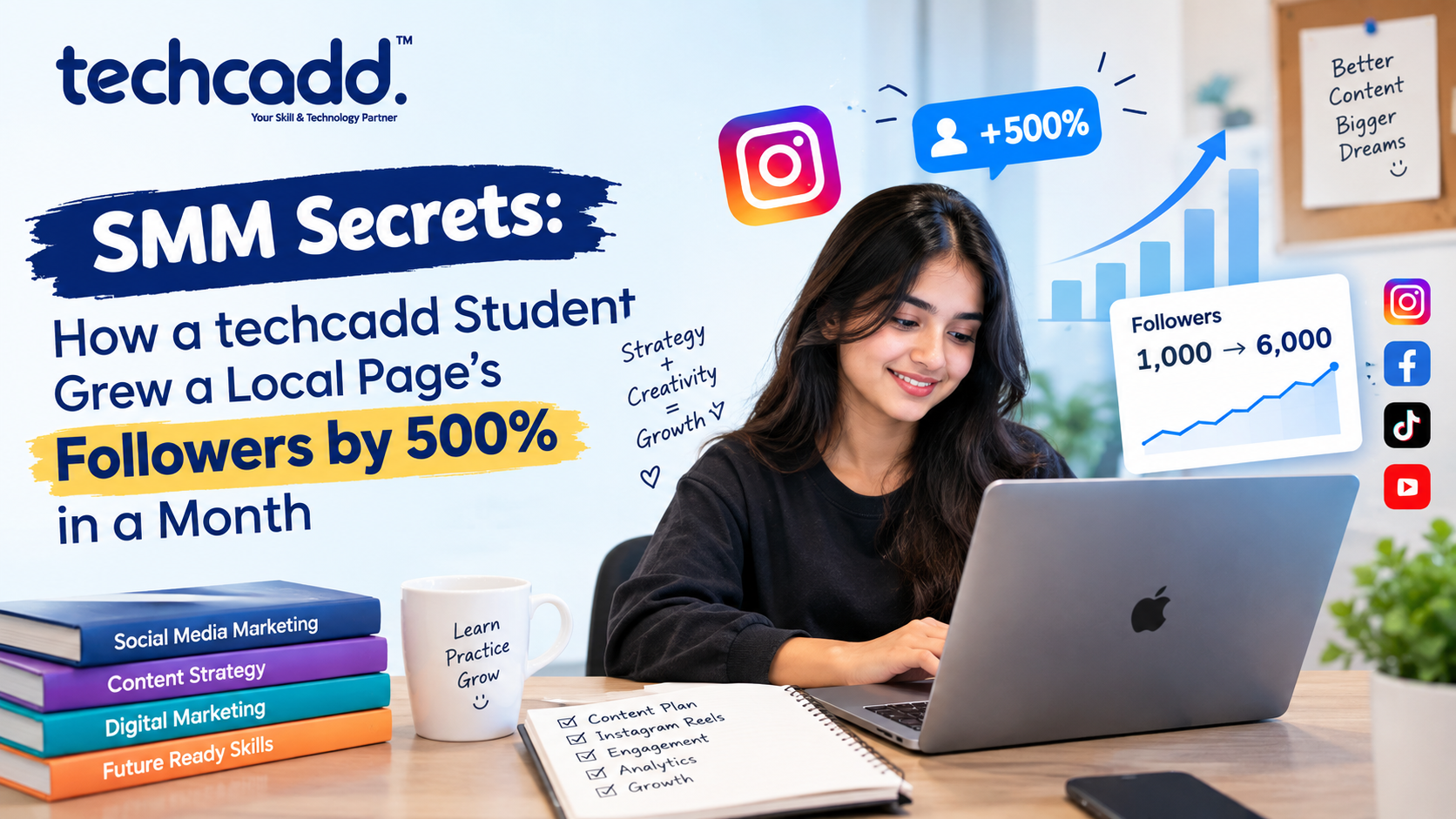
SMM Secrets: How a techcadd Student Grew a Local Page's Followers by 500% in a Month
Social media has become one of the most powerful ways for local businesses to connect with customers. Whether it is a café, salon, clothing store, coaching institute, gym, restaurant, or home-based business, having a strong social media presence can help attract attention, build trust, and bring people closer to making a purchase.
But growing a local business page is not always as simple as uploading a picture and waiting for followers. Many businesses post regularly without understanding what their audience wants to see. Some focus only on selling, while others copy trending content without connecting it to their brand. As a result, their social media pages may look active but fail to create meaningful growth.
This is where Social Media Marketing, commonly known as SMM, becomes important.
Imagine a student learning Social Media Marketing who receives the opportunity to manage a small local business page. The page has a limited number of followers, low engagement, inconsistent content, and almost no clear strategy. Instead of simply posting promotional graphics, the student studies the audience, creates relevant content, improves the page, and tracks performance.
Within one month, the page grows its followers by 500%.
Sounds impressive, right?
But the real secret is not a magic hashtag, a single viral reel, or posting every hour. The real secret is understanding how social media works and using a proper strategy consistently.
This blog explores an illustrative case study of how a Social Media Marketing student can grow a local business page by 500% in one month. It explains the planning process, content strategy, Instagram growth techniques, audience research, engagement methods, analytics, common mistakes, and the practical skills students need to succeed in digital marketing.
By the end, you will understand how a beginner can approach social media marketing professionally and how local businesses can use these strategies to improve their online presence.
What Is Social Media Marketing?
Social Media Marketing is the process of using social media platforms to promote a business, product, service, personality, or organization. It includes creating content, connecting with audiences, building brand awareness, encouraging engagement, and measuring performance.
Platforms such as Instagram, Facebook, YouTube, LinkedIn, and Pinterest offer different opportunities for businesses. A local clothing store may use Instagram Reels to showcase new arrivals. A restaurant may share food videos and customer experiences. A coaching institute may post educational tips, student activities, and course information.
The goal of SMM is not only to increase followers. A successful social media strategy should help a business reach the right people and encourage meaningful actions.
These actions may include:
Following the business page.
Saving useful posts.
Sharing content with friends.
Sending direct messages.
Visiting the business location.
Asking about products or services.
Clicking a website link.
Making an inquiry or purchase.
A large follower count can look attractive, but followers alone do not guarantee business growth. A page with 2,000 relevant local followers may be more useful to a neighborhood business than a page with 20,000 followers from unrelated locations.
This is why professional Social Media Marketing focuses on both visibility and relevance.
Why SMM Matters for Local Businesses
Local businesses often depend on customers from a specific city, neighborhood, or nearby area. Their social media content needs to reach people who can realistically visit, contact, or purchase from them.
For example, a café in Ludhiana may want to reach college students, working professionals, families, and food lovers living nearby. A salon may focus on people interested in beauty services within its service area. A training institute may target students, graduates, and working professionals looking to learn new skills.
Social media allows these businesses to communicate directly with potential customers.
A strong local social media presence can help a business:
Become more recognizable in its area.
Showcase products and services visually.
Build trust through reviews and customer experiences.
Answer questions through comments and messages.
Promote offers, events, and launches.
Create a community around the brand.
Generate inquiries through organic content and paid advertising.
However, these benefits require consistency, audience understanding, and a strategy that matches the business.
Understanding the 500% Follower Growth Case Study
Before discussing the strategy, it is important to understand what 500% growth actually means.
A percentage increase is calculated using the original number of followers.
Formula:
Follower Growth Percentage = ((Final Followers − Initial Followers) ÷ Initial Followers) × 100
Suppose a local business page starts with 1,000 followers.
If it grows to 6,000 followers in one month:
Initial followers: 1,000
Final followers: 6,000
New followers: 5,000
Percentage growth: 500%
The final audience is six times the original audience. The additional followers represent a 500% increase.
This is different from saying the page reached 500% of its original audience. That would mean the page reached five times its starting size, which is a 400% increase.
Illustrative Case Study Snapshot
For this example, imagine a local lifestyle business with the following starting point:
MetricBefore strategyAfter one monthFollowers1,0006,000Net new followers—5,000Follower growth—500%Content approachIrregular postsPlanned contentMain platformInstagramInstagramStrategy focusVisibility and relevanceReach, engagement, and conversion
These figures are illustrative, not verified student results.
The purpose of this case study is to explain the type of planning and execution that could contribute to strong growth. Actual results depend on the business, audience, content quality, platform distribution, competition, and other factors.
A real 500% increase in one month would require careful verification through the platform's analytics.
The Starting Problem: Why the Local Page Was Not Growing
The first step in any social media marketing project is understanding the existing situation.
A beginner may look at a page and immediately think, “We need more reels.”
But a professional marketer asks deeper questions:
Who is the target audience?
What type of content has worked previously?
Why are people not following the page?
Is the page reaching local users?
Are the posts useful, entertaining, or visually attractive?
Is the profile easy to understand?
Are people engaging with the content?
Is the business posting consistently?
Are there clear reasons for users to follow?
In our illustrative case, the local business page had several common problems.
1. Inconsistent Posting
The page uploaded content only when someone remembered to post. There was no clear weekly calendar.
One week might contain four posts, followed by several days without any activity. This made it difficult to maintain a consistent content flow.
Consistency does not mean posting randomly every day. It means following a realistic plan that allows the business to communicate regularly with its audience.
2. Too Much Promotional Content
Many local businesses make the mistake of turning every post into an advertisement.
Examples include:
“Visit us today.”
“Buy now.”
“Best quality products available.”
“Limited-time offer.”
Promotional content has a place in marketing, but a page that only sells may fail to give users a reason to follow.
People use social media for entertainment, discovery, education, inspiration, and connection. A business needs to provide content that fits these reasons.
3. Weak Visual Presentation
The page had inconsistent colors, unclear designs, and images that did not immediately communicate the message.
Social media users scroll quickly. If a post does not catch attention or explain its value, people may move on.
Good design does not require expensive equipment. A clear layout, readable text, relevant images, and consistent branding can improve the presentation.
4. No Defined Audience
The content was created for “everyone.”
But content created for everyone often feels relevant to nobody.
A local page needs to understand its audience's interests, location, age group, lifestyle, problems, and preferences.
For example, content for college students may use a different tone from content for parents or corporate professionals.
5. No Performance Tracking
The business looked at likes but did not regularly check reach, profile visits, shares, saves, or follower growth.
Without analytics, it is difficult to understand which content deserves more attention.
The student realized that the page did not need random posting. It needed a complete Social Media Marketing strategy.
Step 1: Understanding the Target Audience
The first major task was audience research.
Before creating content, the student needed to understand who the local business wanted to attract.
Audience research helps marketers answer questions such as:
Who are our potential customers?
Where do they live?
What problems do they have?
What content do they enjoy?
What motivates them to follow a page?
What questions do they ask before buying?
Which social media platforms do they use?
What makes them trust a local business?
Creating a Customer Persona
A customer persona is a simple profile representing a target customer.
For example, if the page belongs to a local café, one possible audience persona might be:
Name: Simran
Age: 20–28
Location: Nearby city and neighborhood
Interests: Food, cafés, friends, lifestyle, photography
Social media habits: Watches reels, saves food recommendations, shares content with friends
Needs: Affordable food, comfortable seating, attractive presentation, convenient location
This persona helps the student create more relevant content.
Instead of posting generic food pictures, the page could create content such as:
“Three café orders for your next college hangout.”
“POV: You finally found a cozy place to meet your friends.”
“Budget-friendly café options for a weekend outing.”
The content feels more personal because it connects with a specific audience.
Local Audience Research
For local businesses, location is especially important.
A page may receive views from people in different cities or countries, but those views may not translate into customers.
The student studied:
Local competitors.
Popular businesses in the same category.
Common customer questions.
Local content trends.
Audience comments.
Relevant city-based searches.
Posts that received shares and saves.
For example, a business targeting Ludhiana might research content related to local lifestyle, student activities, shopping, food, or professional needs, depending on the industry.
The objective is not to copy competitors. It is to understand what the local audience finds relevant.
Why Audience Research Matters
Without research, content creation becomes guesswork.
With research, the marketer can develop content that answers real questions and fits the audience's interests.
This is one of the most important skills taught in practical digital marketing: creating content based on audience needs instead of personal assumptions.
Step 2: Improving the Instagram Profile
Before trying to increase followers, the student reviewed the business profile.
This step is often overlooked.
Imagine someone discovers a business through a reel. They visit the profile and see an unclear username, no useful bio, random highlights, and no obvious information about the business.
Even if the reel performed well, the visitor may not follow.
A strong profile helps turn profile visitors into followers.
Profile Optimization Checklist
Clear Username
The username should be simple, recognizable, and connected to the business.
Avoid unnecessary numbers or confusing spellings when possible.
Recognizable Profile Picture
A business logo or clear brand image helps people identify the page.
Useful Bio
The bio should communicate:
What the business offers.
Where it operates.
Who it serves.
What users should do next.
For example:
“Fresh bakes and coffee in Ludhiana ☕
Made for your everyday cravings.
Visit us or DM for today's menu.”
This is only an example. The actual bio should match the business.
Contact Information
If relevant, include contact buttons, business location, WhatsApp details, or a website link.
Highlights
Instagram Highlights can organize important information such as:
Products.
Services.
Reviews.
Location.
FAQs.
Offers.
Behind the scenes.
Pinned Posts
Pinned posts can introduce the business, explain its main offerings, or show important information.
The student understood that profile optimization was part of follower growth. A visitor should quickly understand why the page is worth following.
Step 3: Building a Content Strategy
After audience research and profile optimization, the student created a content strategy.
A content strategy is a planned approach to deciding what to post, for whom, when, and why.
Instead of asking, “What should we upload today?” the student asked:
“What content can help this business reach its target audience and build a stronger relationship with potential customers?”
The Four Main Content Pillars
For this illustrative case, the student used four content pillars.
1. Educational Content
Educational content helps the audience learn something useful.
Examples:
Tips related to the business industry.
Common mistakes customers make.
Simple how-to videos.
Product selection advice.
Frequently asked questions.
Industry-related information.
If the page belongs to a skincare business, educational content might explain basic skincare habits.
If it belongs to a computer training institute, educational content might include beginner technology tips, career-related information, or software tutorials.
Educational content can build trust because it demonstrates knowledge.
2. Entertaining and Relatable Content
Relatable content connects with everyday experiences.
Examples:
Student struggles.
Customer situations.
Funny industry moments.
Common buying habits.
Local lifestyle experiences.
Popular trends adapted to the business.
For a local business, relatable content can make the brand feel more human.
A training institute could create a reel about a student saying, “I will learn a new skill tomorrow,” followed by the familiar reality of postponing it.
The key is to connect the humor to the business naturally.
3. Product or Service Content
This content shows what the business actually offers.
Examples:
Product demonstrations.
Service explanations.
New arrivals.
Before-and-after visuals where appropriate.
Features and benefits.
Customer experiences.
Frequently asked questions.
Product content should explain why the offering matters rather than only saying, “Buy now.”
4. Community and Trust Content
This content helps people connect with the business.
Examples:
Customer reviews.
Team introductions.
Behind-the-scenes clips.
Local events.
Business milestones.
Customer-generated content.
Community participation.
Trust content is particularly useful for local businesses because customers often want to know who is behind the brand.
Content Pillar Balance
A page does not need to follow a fixed percentage formula. The balance should depend on the audience and business goals.
For example, a weekly plan might include:
Content typePurposeEducationalHelp and informRelatableAttract attentionProduct/serviceExplain the offeringCommunity/trustBuild familiarityPromotionalEncourage inquiries or visits
The student made sure that promotional content was not the only type of content on the page.
Step 4: Using Instagram Reels for Reach
Instagram Reels became an important part of the student's strategy.
Short-form video can help businesses communicate ideas quickly and show products, services, people, and experiences in an engaging format.
However, creating a reel does not guarantee that it will go viral.
The student focused on making videos that were relevant, clear, and worth watching.
What Makes a Reel More Engaging?
A reel can benefit from:
A strong opening.
Clear visuals.
A focused message.
Good pacing.
Relevant audio or sound.
Readable text.
A clear ending.
Content that fits the target audience.
The first few seconds are important because viewers decide quickly whether to continue watching.
Example Reel Structure
For a local clothing store:
Opening: “Still searching for an outfit for your next outing?”
Middle: Show three outfit options.
Value: Explain where each outfit may fit.
Ending: “Save this for your next shopping day.”
This approach provides a reason to watch and save the reel.
The Importance of Original Content
The student avoided relying only on copied videos.
Original content allows a business to show its actual products, team, location, services, and personality.
For local businesses, this is valuable because customers want to see what makes that particular business different.
A restaurant can show its own kitchen. A salon can show its own work. A training institute can show classroom activities. A boutique can show real products.
Original content also helps maintain brand consistency.
Using Trends Carefully
Trends can help content feel current, but not every trend suits every business.
The student followed relevant trends and adapted them to the local business.
For example, a popular audio trend could be used to show a relatable customer situation. A trending format could be adapted to explain a product or service.
The focus remained on relevance, not blindly following every trend.
Step 5: Creating a 30-Day Content Calendar
A content calendar helped the student organize the month.
A content calendar includes the content idea, format, caption direction, posting date, and objective.
It reduces last-minute work and makes it easier to maintain consistency.
Sample 30-Day Social Media Marketing Calendar
The following is an illustrative plan for a local business. The exact frequency should be adjusted according to the business's resources.
Week 1: Introduction and Awareness
Day 1: Introduce the business and explain what it offers.
Day 2: Share an educational tip related to the industry.
Day 3: Publish a relatable reel about a common customer situation.
Day 4: Show a product, service, or behind-the-scenes moment.
Day 5: Share a customer question and answer it.
Day 6: Publish a local lifestyle-related reel connected to the business.
Day 7: Review the first week's performance.
The goal of the first week was to make the page more active and understandable.
Week 2: Engagement and Community
Day 8: Publish a question-based post.
Day 9: Share a product demonstration.
Day 10: Create a short educational reel.
Day 11: Post a customer review or experience.
Day 12: Share a relatable industry meme.
Day 13: Publish a behind-the-scenes video.
Day 14: Review engagement and identify useful content patterns.
The focus was to encourage interaction and understand the audience's interests.
Week 3: Reach and Discovery
Day 15: Create a reel with a strong opening.
Day 16: Share a useful checklist.
Day 17: Publish a local audience-focused post.
Day 18: Show a product or service in action.
Day 19: Create a relatable short-form video.
Day 20: Share a customer question or FAQ.
Day 21: Review reach, shares, saves, and profile visits.
The student used the insights to refine the remaining content.
Week 4: Trust and Conversion
Day 22: Introduce a team member or business owner.
Day 23: Share an educational carousel.
Day 24: Publish a customer experience.
Day 25: Create a product-focused reel.
Day 26: Share a common mistake and its solution.
Day 27: Publish a community-related post.
Day 28: Create a recap or best-performing content variation.
Day 29: Share a clear business-related call to action.
Day 30: Review the complete month's performance.
This calendar is a planning example, not a guarantee of 500% follower growth.
Why a Content Calendar Works
A content calendar helps the marketer:
Stay organized.
Avoid repetitive content.
Maintain consistency.
Plan content around business goals.
Coordinate design and video work.
Review performance systematically.
It also helps the business owner understand what is being published and why.
Step 6: Writing Captions That Encourage Engagement
A caption is more than a description of a post.
A good caption can provide context, explain value, encourage interaction, and guide users toward the next step.
The student improved captions by making them more conversational and audience-focused.
The Problem With Generic Captions
Consider this caption:
“Best products available. Visit us today. Contact us now.”
It may communicate the basic message, but it does not give the audience much reason to interact.
A stronger caption explains a specific benefit.
For example:
“Looking for a simple outfit that works for college, coffee dates, and weekend plans? Here are three easy styling ideas to save for later. Which one would you wear?”
This caption is more specific and invites a response.
Caption Structure
A practical caption structure may include:
Hook: Start with a relatable statement or question.
Value: Explain the useful information or highlight.
Context: Add relevant business information.
Call to action: Ask users to save, share, comment, visit, or inquire when appropriate.
Example Caption for a Local Café
“Your next coffee break deserves a little more comfort. ☕
Whether you're catching up with friends or taking a quiet break, a good café moment can make the day better.
Save this for your next café plan and tag someone who needs a coffee date.
Visit us in Ludhiana.”
This is an illustrative caption. It should be adapted to the actual business.
Avoiding Overuse of Hashtags
Hashtags can help categorize content, but using large numbers of unrelated hashtags does not guarantee reach.
The student focused on relevant hashtags connected to:
The business category.
The local area.
The content topic.
The target audience.
For example, a local food business might use relevant food and city-based hashtags where appropriate.
The strategy was relevance rather than hashtag stuffing.
Step 7: Using Local SEO Principles in Social Media
Social Media Marketing and local SEO are different disciplines, but they can support each other.
Local SEO helps businesses become more discoverable in location-based searches. Social media helps businesses communicate with audiences and build visibility.
The student used local relevance throughout the page.
Location-Based Content
A local business can include its city or neighborhood naturally in:
Profile bio.
Captions.
Video text.
Relevant hashtags.
Location tags.
Business information.
Customer stories.
For example, a training institute serving Ludhiana may create content around student life, skill development, and local career interests.
A restaurant may create content around local food preferences or nearby occasions.
Why Local Relevance Matters
People often search for businesses using phrases such as:
Best café near me.
Computer training institute in Ludhiana.
Salon near my location.
Best boutique in the city.
Digital marketing course in Ludhiana.
Social media content can help users discover the business and learn more about it.
However, social media visibility should not be confused with guaranteed search rankings. Google Business Profile optimization, website SEO, customer reviews, and other local SEO factors may also matter.
The student understood that social media was one part of the broader digital marketing system.
Step 8: Engaging With the Audience
Posting content is only one part of Social Media Marketing.
The student also focused on community engagement.
This involved responding to comments, answering questions, and paying attention to the audience's reactions.
Why Engagement Matters
Engagement can help a business understand what its audience thinks about the content.
Comments may reveal:
Customer questions.
Product preferences.
Common concerns.
Content ideas.
Buying intent.
Feedback about the business.
For example, if several users ask about pricing, location, timings, or availability, the business can create content answering those questions.
Responding to Comments
A good response should be relevant and respectful.
Instead of replying to every comment with the same “Thank you,” the student encouraged meaningful conversation.
Example:
User: “Do you have weekend appointments?”
Business: “Yes, weekend appointments are available. Please DM us with your preferred date so we can guide you.”
This type of response is helpful and can move a conversation toward an inquiry.
Using Direct Messages
Direct messages can be useful when users ask for details that are not suitable for public comments.
The business should respond professionally and avoid making promises it cannot fulfill.
For a local training institute, a student may ask:
“Which course is suitable for a beginner?”
The page can answer with basic information and guide the person toward the correct course details.
Community Building Is Long-Term
Not every comment leads to a sale.
Some people engage because they enjoy the content. Others may become customers later.
The student focused on building a page that people recognized as useful, relevant, and trustworthy.
Step 9: Understanding Instagram Analytics
One of the biggest differences between a beginner and a professional Social Media Marketer is the ability to understand analytics.
The student did not judge success only by likes.
Instead, the student reviewed multiple metrics.
Important Social Media Metrics
Reach
Reach refers to the number of unique accounts that saw the content.
It helps show how widely the content was distributed.
Impressions or Views
Depending on the platform and content type, impressions or views indicate how often content was displayed or watched.
These metrics are not always directly comparable.
Engagement
Engagement may include likes, comments, shares, saves, and other interactions.
Different platforms calculate engagement in different ways.
Profile Visits
Profile visits show how many people opened the business profile.
This can help indicate whether content encouraged users to learn more.
Follower Growth
Follower growth measures how the audience changes over time.
It is important to track both new followers and unfollows.
Link Clicks
If the page includes a website or contact link, link clicks can help measure interest in the next step.
Direct Messages
Messages can indicate questions, interest, or potential inquiries.
Why Likes Are Not Enough
A post may receive many likes but very few profile visits.
Another post may receive fewer likes but generate more saves, shares, and inquiries.
For a local business, the second post may be more useful depending on its objective.
The student learned to connect metrics with goals.
If the goal is awareness, reach and views may matter.
If the goal is engagement, comments, shares, and saves may be relevant.
If the goal is inquiries, profile actions, messages, and clicks may matter.
Example Analytics Review
Imagine the page posted two reels.
MetricReel AReel BViews20,0008,000Shares100450Saves80300Profile visits250600New followers50180
Reel A received more views, but Reel B produced more shares, saves, profile visits, and new followers.
This illustrates why marketers should review several metrics instead of focusing only on views.
These figures are hypothetical.
Step 10: Identifying the Content That Worked
During the month, the student reviewed which content formats performed well.
The goal was not to declare one format universally best. The goal was to understand what worked for this specific page.
Content Performance Questions
The student asked:
Which topics received the most shares?
Which reels brought profile visits?
Which posts received saves?
Which content attracted local users?
Which captions encouraged comments?
Which visuals made the message clearer?
Which posts generated business inquiries?
Learning From High-Performing Content
Suppose a local clothing page discovers that styling reels receive more shares than ordinary product photos.
The student might create more styling-related content.
If customer review videos generate more profile visits, the page could include more trust-focused content.
If educational posts receive saves, the business could develop a series around helpful tips.
This is called performance-based content optimization.
Do Not Copy Viral Content Blindly
A post that performs well for one business may not work for another.
A comedy reel that attracts students may not be suitable for a premium professional service.
The student used the analytics to understand the audience rather than simply copying popular content.
Step 11: Creating Better Visuals With Design Tools
Good Social Media Marketing often requires strong visual communication.
The student used design tools to improve the appearance of posts, stories, and promotional graphics.
Tools such as Canva and Adobe Photoshop can help marketers create:
Instagram posts.
Reels covers.
Story designs.
Promotional banners.
Infographics.
Educational carousels.
Brand templates.
Why Design Skills Matter
A marketer may have a great content idea, but poor design can make it difficult to understand.
A strong visual should have:
A clear main message.
Readable typography.
Consistent branding.
Suitable colors.
Relevant imagery.
Good spacing.
A clear visual hierarchy.
Creating a Brand Style
The student developed a consistent visual style for the page.
This included:
A limited color palette.
Consistent fonts.
A recognizable logo placement.
Similar design patterns.
Consistent reel cover style.
Brand consistency helps users recognize content from the same business.
However, consistency does not mean every post must look identical. The page can use different formats while maintaining recognizable branding.
Design Tools for Students
Students learning digital marketing may explore tools such as:
Canva: Useful for quick social media graphics, templates, presentations, and content design.
Adobe Photoshop: Useful for detailed image editing, creative compositions, and advanced design work.
CapCut or other video editors: Useful for short-form video editing, captions, transitions, and pacing, subject to platform and regional availability.
The exact tools depend on the student's course and project requirements.
Step 12: Understanding Paid Advertising
Organic social media and paid advertising are two different parts of SMM.
Organic content is published without paying the platform for distribution. Paid advertising involves spending money to promote content or reach selected audiences.
The student first focused on improving the organic content strategy.
After understanding the page, paid advertising could be considered as an additional method.
What Is Meta Advertising?
Meta Ads are advertisements delivered through Meta's advertising system, which includes platforms such as Facebook and Instagram.
Businesses can use advertising to promote products, services, content, or offers to selected audiences.
Common campaign objectives include:
Awareness.
Traffic.
Engagement.
Leads.
Sales.
The objective should match the business goal.
Why Advertising Requires Planning
Paid advertising is not simply about boosting every post.
A marketer needs to understand:
Campaign objective.
Target audience.
Creative.
Budget.
Landing page or contact process.
Tracking.
Follow-up.
Cost per result.
For a local business, the target audience may be limited by location and customer needs.
Organic and Paid Content Work Together
Organic content helps a business develop its brand voice and understand what resonates with its audience.
Paid advertising can then be used to distribute suitable content to a selected audience.
However, paid reach does not guarantee followers, sales, or profitable results.
The student learned that advertising should be measured against the actual business objective.
Step 13: The Role of AI in Social Media Marketing
Artificial Intelligence is becoming increasingly useful in digital marketing.
Students can use AI tools to support research, brainstorming, content planning, and workflow improvement.
The student used AI as an assistant rather than treating it as a replacement for strategy.
How AI Can Help
AI tools may support:
Caption ideas.
Content calendar brainstorming.
Reel script drafts.
Audience question analysis.
Content repurposing.
Headline variations.
Basic competitor research planning.
Social media reporting summaries.
Example: AI-Assisted Content Planning
Suppose the business is a local fitness studio.
A student can ask an AI tool to generate content ideas around:
Beginner workout mistakes.
Healthy lifestyle habits.
Gym FAQs.
Motivational but realistic fitness content.
Member experiences.
The student then reviews the ideas and adapts them to the business.
Human Creativity Still Matters
AI-generated content may be generic, inaccurate, or unsuitable for a particular audience.
A professional marketer needs to check:
Whether the information is correct.
Whether the tone fits the brand.
Whether the content feels original.
Whether it reflects the actual business.
Whether it makes realistic claims.
The student used AI to save time but kept strategy, quality control, and brand decisions human-led.
Step 14: Common Mistakes That Stop Social Media Growth
Many businesses struggle with social media because they repeat the same mistakes.
Understanding these mistakes helped the student improve the page.
Mistake 1: Posting Without a Goal
A business posts simply because it feels necessary.
But every content piece should have a purpose, such as awareness, engagement, education, trust, or conversion.
Mistake 2: Copying Competitors
Copying another page's content may make the business look unoriginal.
Competitor research should be used for learning, not imitation.
Mistake 3: Ignoring the Audience
A business may post content it likes, but the audience may not find it useful.
Audience research helps create relevant content.
Mistake 4: Using Irrelevant Hashtags
Unrelated hashtags can make content less focused.
Relevant hashtags and clear captions are more useful than hashtag stuffing.
Mistake 5: Buying Followers
Buying followers may increase the visible follower count, but it does not guarantee genuine interest or business value.
Fake or irrelevant accounts can distort analytics and reduce the usefulness of the audience.
The student focused on attracting relevant followers through content and engagement.
Mistake 6: Ignoring Comments and Messages
A business that does not respond to questions may lose potential customers.
Community management is an important part of SMM.
Mistake 7: Changing Strategy Too Quickly
One underperforming post does not mean the entire strategy has failed.
Content performance can vary.
The student reviewed patterns over time rather than making decisions based on one post.
Mistake 8: Making Unrealistic Promises
Marketing content should not promise guaranteed results.
Statements such as “You will become successful in seven days” or “This strategy guarantees 10,000 followers” can be misleading.
Professional marketers use realistic, evidence-based claims.
Step 15: Measuring the 500% Growth
At the end of the month, the student reviewed the account's analytics.
The illustrative starting follower count was 1,000.
The illustrative final follower count was 6,000.
Follower Growth Calculation
Initial followers = 1,000
Final followers = 6,000
New followers = 6,000 − 1,000 = 5,000
Percentage growth:
(5,000 ÷ 1,000) × 100 = 500%
Therefore, the page experienced a 500% increase in followers.
What the Student Needed to Verify
To report this as a real case study, the student would need to verify:
The initial follower count.
The final follower count.
The exact reporting period.
The number of new followers.
The number of unfollows.
Whether the account was organic or paid.
The source of follower growth.
Whether the followers were relevant to the business.
Whether the analytics screenshots or reports support the figures.
Without this evidence, the 500% figure should remain an illustrative example.
Why Follower Quality Matters
A page may grow quickly through broad content, giveaways, paid promotion, or viral videos.
But the business should also ask:
Are the new followers interested in the product?
Are they from the target location?
Are they engaging with future content?
Are they sending inquiries?
Are they likely to become customers?
A relevant audience is important for long-term business growth.
Step 16: What the Student Learned From the Project
The project was not only about increasing followers.
It helped the student understand how different digital marketing skills work together.
1. Audience Research
The student learned how to identify target audiences and understand their interests.
2. Content Planning
The student learned how to create a calendar and organize content around goals.
3. Copywriting
The student learned how to write captions, hooks, and calls to action.
4. Graphic Design
The student improved the visual presentation of social media content.
5. Video Editing
The student learned how to create short-form videos and reels.
6. Analytics
The student learned how to review metrics and improve future content.
7. Community Management
The student learned how to communicate with users professionally.
8. Digital Marketing Strategy
The student understood that social media growth requires more than random posting.
These skills are useful for students interested in digital marketing careers, freelance social media management, content creation, and agency work.
Step 17: How Beginners Can Start Learning SMM
A student does not need to become an expert before beginning practical work.
The learning process can start with basic concepts and gradually move toward real projects.
Start With Social Media Fundamentals
Learn:
What Social Media Marketing means.
How different platforms work.
Organic versus paid marketing.
Target audiences.
Content pillars.
Engagement.
Hashtags.
Social media analytics.
Practice Content Creation
Create sample posts for imaginary businesses.
For example:
A café.
A salon.
A clothing store.
A gym.
A training institute.
A local restaurant.
This helps students develop creativity and practical understanding.
Learn Basic Design
Practice creating:
Static posts.
Carousels.
Story designs.
Reel covers.
Promotional graphics.
Learn Video Editing
Practice:
Cutting clips.
Adding captions.
Using transitions.
Improving pacing.
Creating short-form videos.
Understand Analytics
Learn how to read reach, engagement, profile visits, follower growth, and other relevant metrics.
Work on a Real Project
A real business project helps students understand:
Client requirements.
Brand guidelines.
Content approvals.
Posting schedules.
Reporting.
Communication.
Practical experience can make the learning process more meaningful.
Step 18: Tools Every Social Media Marketing Student Should Explore
Social Media Marketing involves several tools. Each tool serves a different purpose.
Meta Business Suite
Meta Business Suite helps businesses manage and monitor content across supported Meta platforms.
It can be used for tasks such as content scheduling, managing messages, and reviewing insights, depending on the account and available features.
Instagram Insights
Instagram Insights provides performance information for professional accounts.
It helps marketers understand content reach, engagement, audience information, and account activity.
Canva
Canva is a design platform that helps users create social media graphics, presentations, and other visual content.
Adobe Photoshop
Photoshop is useful for advanced image editing, creative compositions, and detailed design work.
Google Sheets
Google Sheets can be used to maintain content calendars, track metrics, organize ideas, and prepare reports.
Google Analytics
Google Analytics helps businesses understand website traffic and user behavior.
It is especially useful when social media content sends users to a website.
Meta Ads Manager
Meta Ads Manager is used to create, manage, and measure Meta advertising campaigns.
AI Content Tools
AI tools can support brainstorming, caption drafting, and content planning.
The student learned that tools are valuable only when used with a clear marketing strategy.
Step 19: How Businesses Can Turn Followers Into Customers
Follower growth is only one part of the journey.
A business also needs to create a clear path from social media discovery to customer action.
Build Trust
Show real products, services, customer experiences, and business information.
Provide Clear Information
Make it easy to understand:
What you offer.
Where you are located.
How to contact you.
What your products or services cost, when appropriate.
How to place an order or make an inquiry.
Use Relevant Calls to Action
A call to action should match the content.
Examples:
“Save this for later.”
“Send us a message for details.”
“Visit our store.”
“Check the link in our bio.”
“Share this with a friend.”
Make the Next Step Simple
If a user is interested, they should not have to search through multiple pages to find contact information.
Clear profile details and helpful responses can make the process easier.
Track Business Results
Depending on the business, track:
Messages.
Calls.
Website clicks.
Form submissions.
Store visits where measurable.
Bookings.
Sales attributed to campaigns.
The exact measurement method depends on the business and its tracking setup.
Step 20: Why Practical Projects Matter in Digital Marketing Education
Learning theory is important, but practical projects help students understand how marketing works in real situations.
A student may know the definition of engagement, but managing a real page teaches them how to respond when engagement is low.
A student may understand content calendars, but planning a month's content for a business teaches them how to work with actual requirements.
A student may know analytics terms, but reviewing real performance data teaches them how to make decisions.
Practical Learning Helps Students Develop
Problem-solving skills.
Communication skills.
Content planning ability.
Creative thinking.
Analytical thinking.
Client-handling skills.
Time management.
Confidence in using digital marketing tools.
The illustrative 500% case study shows how a social media project can become a learning experience.
The most valuable outcome is not simply a follower count. It is the student's ability to understand the process and apply the skills to future projects.
The Bigger Lesson Behind the 500% Growth
The headline “500% follower growth in one month” attracts attention, but the real lesson is the strategy behind the number.
Social Media Marketing is not about uploading random content and hoping for viral results.
It involves:
Understanding the audience.
Defining business goals.
Optimizing the profile.
Creating relevant content.
Using suitable formats.
Engaging with the community.
Reviewing analytics.
Improving the strategy.
Measuring meaningful results.
A strong social media marketer is someone who can connect creativity with business objectives.
The student in this illustrative case learned that a local business page can become more organized, engaging, and discoverable when marketing decisions are based on research and performance.
However, follower growth is influenced by many factors, and no single strategy guarantees a 500% increase in one month.
Businesses should focus on building a relevant audience and creating content that supports long-term growth.
How techcadd Helps Students Learn Digital Marketing Skills
For students who want to build a career in digital marketing, practical learning can make a significant difference.
At techcadd, students can explore digital marketing concepts and develop skills related to Social Media Marketing, content creation, SEO, Google Ads, Meta Ads, analytics, and other areas of online marketing, depending on the course structure.
Learning SMM involves more than understanding how to upload a post. Students need to understand audience research, content planning, social media strategy, campaign objectives, engagement, analytics, and the tools used by marketers.
Practical projects can help students understand how these concepts work in real business situations.
If you are interested in learning digital marketing in Ludhiana, explore the available training options at techcadd and understand which course matches your learning goals.
The goal is to learn useful skills, practice them, and gradually build the confidence needed to work on real digital marketing projects.
Conclusion
The illustrative case study of a techcadd student growing a local business page by 500% in one month highlights the importance of strategy in Social Media Marketing.
The growth figure is impressive as an example, but the real learning comes from the work behind it: audience research, profile optimization, content planning, reels, engagement, analytics, and continuous improvement.
For local businesses, social media can become a valuable way to connect with nearby audiences, showcase offerings, and build trust.
For students, SMM offers opportunities to develop creative, analytical, and practical digital marketing skills.
Whether you are a business owner trying to improve your Instagram page or a student planning to learn digital marketing, the key is to focus on relevant content, consistent execution, and measurable goals.
Social media growth is not always predictable. But with the right knowledge, practical experience, and a willingness to learn, businesses and students can build a stronger foundation for digital success.
Learn. Practice. Grow with techcadd.